Daredevil.

This one was tough. I really wanted to like it, but you can’t always get what you want. Still, with the Daredevil Netflix series now streaming on Netflix, I think it’s time for a look back at the first time Marvel tried to launch a live-action Man Without Fear tale.

At the risk of sounding like a grandpa, I think it will be hard for future generations to fathom that we lived in a world without really good comic book movies for a long time. Ok, so there were the Batman movies, which started out promising with Tim Burton at the helm, and really went downhill in under Joel Schumacher’s direction (like, really downhill.) Christopher Reeves as Superman also had about two watchable movies in him before the third and fourth installments fizzled pretty badly. Plus, that series ended, mercifully, by the late 80’s. It wasn’t until Marvel started making a real effort with the X-Men and Spider-Man franchises that fans could get their hopes up.

And then, Daredevil came out in 2003. #Hopes dashed.

It was a sad case, really. When I first started reading comics, Daredevil was sort of Spider-Man’s bastard cousin. You know, a guy in red who swings around the city fighting bad guys. Plus, his nemesis was the Kingpin, whom I had first seen in Spider-Man comics and who I assumed was actually Spidey’s main baddie. I guess I thought nemeses were like spouses; you should really only have one, even if you mess around a little. As I grew older and read more Daredevil books, I realized he was his own man, and he had a rich history, despite not being what you might call an “A-lister.” Still, seeing DD on the big screen would legitimize the character and put him in that top tier. Still below Spidey perhaps, but definitely above Moon Knight.

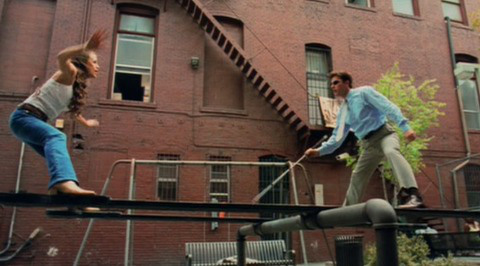
Instead, this film may have set the character back a decade (since it took twelve years to get this series, and without Netflix, well… who knows?). It’s hard to even pinpoint the exact point where the movie went bad, because when I think back, it was pretty much all bad. Ben Affleck was in full-on super-hero mode, all brooding and intense, while Colin Farrell was in full-on super-villain mode, meaning he spoke in a raspy voice and generally acted all crazy (I literally thought he was going to twist his moustache at one point.) It was kind of weird when Jennifer Garner, as DD’s love interest, Elektra, became the highlight of the movie. Except for that classic see-saw scene. That was the real highlight. Pure, unintentional, comedic gold!
daredevil-seesaw-2003

“I’ll impress her with my Blind-See-Saw-dance. The chicks really dig it.”

Strangely enough, Garner apparently impressed the studio execs so much, and they must have thought that there was money to be made, that they gave her a spin-off, despite the fact that she died in Daredevil. This being comics, nobody really cared about that bit, but I have heard that Elektra was actually worse than Daredevil, so that one must be pretty bad. I never bothered to watch it. Time being precious and all.

If that introduction didn’t get you fired up to watch this movie, here’s the skinny on Daredevil: Matt Murdock is a blind, grumpy attorney by day, but by night he puts on a costume and plays hero on the streets of Hell’s Kitchen, ostensibly to avenge the death of his father, boxer Jack Murdock, who I guess was screwed over by somebody at some point. How does a blind person fight crime, you ask? Well, the same toxic chemical accident that robbed him of his sight also heightened his other senses, so Matt can hear and smell things that no normal person can. He also has a heightened radar sense (related, apparently, to his super-hearing) that allows him to sort of “map out” structures and people and basically sense where everything is, so he gets around pretty good, all things considered. The downside is that he has to sleep in an isolation tank or else the city noise would keep him up all night. That’s probably why he’s so grumpy.

Through his exploits, Matt meets Elektra Natchios, a ninja assassin who is also trying to avenge the death of her father. The crime lord that they are both after, Wilson Fisk, a.k.a. “The Kingpin,” played with generous moxie by the late Michael Clarke Duncan, hires Bulls-eye (Farrell) to take the good guys out. Farrell’s power is, shockingly, really good aim, so he throws things at his foes. Shouldn’t he have just been a major league pitcher? He could have made millions and not gone to jail. Anyway, he succeeds in taking out Elektra, but Daredevil defeats him, and then goes on to defeat Fisk, as well, and justice is served. Yay! Good guys win!

I realize that no one goes to see Daredevil expecting Shakespeare, but that’s a pretty meager plot. I summed it up in just a couple sentences, and that was with that bad joke about Bulls-eye thrown in. This leads one to believe that the writing is bad, and it is. Even a glance at the quotes on IMDB reveals some horrid writing:

Daredevil: You killed the only two people I ever loved. Why?

Kingpin: Business. That’s all it ever is, is business. I was working for Fallon at the time, your father was supposed to throw a fight. And your girl was in the wrong family at the wrong time. It’s all business… and you’ve been in my business for too long!

As riveting as all that sounds on paper, I am sure that Affleck played it with his usual aplomb, the kind of line-reading that is usually reserved for Simpsons’-style movie parodies (“You killed… the only two people… I ever loved… Now, get… Mendoza.”). And Colin Farrell, as mentioned above, must have been taking cues directly from Arnold Schwarzeneggar’s “How to Play a Super-Villain.” Or maybe just playing himself. Hard to tell.
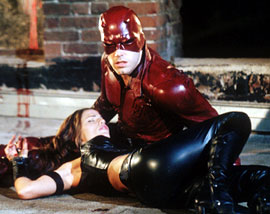
"Mendooozzzzaaaaaa!"

“Mendooozzzzaaaaaa!”

Simply put, the script was bad. The story was flimsy. The acting was over-the-top. There were no eye-popping special effects. There wasn’t even any nudity. I can’t think of any reason to actually watch this movie. Other than the fact that it was called “Daredevil” and I’m a comic book geek, I don’t even know why I saw it. Even a grumpy, blind lawyer could see that this isn’t worth your time. Thankfully, Disney has resurrected the character with the Netflix series, because nobody dies in comics. Although after this movie, I almost wished I was.
Like a fine meal, I sometimes like to see how movies settle.  I have often left a theater feeling good about how I just spent the last couple hours, only to completely change my mind upon further reflection.  Some movies don’t stand the test of time, and a second viewing reveals all the flaws and plot holes.  In fact, about 90% of all films can be described this way. Conversely, some movies get better with age.

Marvel’s The Avengers had the biggest opening weekend of all-time (probably until the next one) and will probably rank among the highest grossing films ever, and the highest not made by James Cameron (Of course, at $14.00 a ticket, there’s no way it wasn’t going to).  After seeing it on opening day, I left the theater feeling good about myself.  When people asked what I thought, I said it was “fun,” which is true.  It was a fun, popcorn, mostly-brainless, fluff piece.  The 3D was pretty pointless, but if we have to have 3D in our lives, my attitude is “Do no harm,” which this instance did not.  There was just the right amount of humor, and ridiculous amounts of action, to make it worth the money.  Every character had a good amount of time and development, and considering all the stars that had to align to make the thing, Joss Whedon should be awarded an Oscar just for getting it done.  So, plusses all around, right?

Not so fast.  With a slight twist, or on the wrong day, a lot of those plusses can be flipped.  The “right amount of humor” could be changed to “borderline silly” with one more bad pun.  Each character getting their time to develop can also mean that it got a little long-winded (It did!) while they fleshed out seven heroes and a major baddie.  It could be argued that the 3D “doing no harm” was actually, in fact, pointless.  “Ridiculous amounts of action” can be spun as just plain “ridiculous.” Catch me on an off day, and those factors suddenly become major stumbling blocks to my enjoyment.

This is why movies are both great and cripplingly annoying at the same time.  The things that bother me seldom bother anybody else, and even when I point out a movie’s foibles, other people will agree with me and yet not change their opinion.  Which is good, because, I mean, what do I know? (I did once have a friend rail against me for telling her The Hunger Games sucked, shouting, “Just stop talking because I want to like it and you can’t stop me!”)  I tend to think that all movies should be judged with the same measuring stick, but most people tend to group movies in ways that often allow bad movies to get a pass.  Obviously, the expectations for the next Liam Neeson action movie are such that there will probably be no Oscars in Oscar Schindler’s future, but he makes millions of dollars and people seem to enjoy watching him use his “particular set of skills,” so why bother with story, eh?

The Avengers did manage to do both.  It is unique in being a sequel to five different films, with each one being a franchise on its own.  You would think that fact would set the bar incredibly high because they have been building up to this for many years.  However, when looking at the core audience for The Avengers, maybe it would have been hard for people to not like it.  Comic book fans have been drooling about this for eons, it would have to have been a disaster of Phantom Menace proportions for them not to enjoy it.  Entirely possible, of course, but unlikely, because it seems that if Hollywood has learned one thing over the last ten years or so, it is don’t piss off the fanboys.  Does this mean, though, that Avengers is a good movie, or did people will it good?

The film begins with Thor’s sniveling half-brother, Loki, exiled at the end of Thor, in league with an unseen force, conspiring to destroy Earth and capture an alien artifact called The Tessaract (which is apparently alien for “glowing cube of doom”), seen at the end of Thor and Captain America.  Basically, if you missed Thor and don’t read comics, you’re kind of out in Jotunheim so far.  Loki succeeds in obtaining the cube, and also using his mind trickery to control SHIELD agent Clint Barton and scientist Stellan Skarsgard (who both appeared in, you guessed it, Thor.  For a Marvel comic that not many people care about, this film sure owes a lot to that one.)

In an effort to stop Loki, SHIELD honcho Nick Fury (Samuel L. Jackson, having way too good a time to collect a paycheck) calls in his team of Avengers; beings with extraordinary powers that he has been keeping an eye on throughout the previous five movies.  At this point, it’s just Captain America, Black Widow and Iron Man, but they are able to capture Loki and cart him back to their floating headquarters.  However, on the way, Thor swoops in and grabs his half-brother, wanting to keep it in the family.  This sets up one of the most interesting sequences in the movie, as Iron Man and Cap confront Thor and we get the first sense that these guys don’t really like each other. Thor tries to fry Iron Man with some godly lightning and Iron Man’s armor absorbs it and turns it into energy, which was pretty awesome. Still, their squabble is brief, and they eventually all agree to hang together and see how this SHIELD thing plays out. Fury has also brought Bruce Banner into the fold, but for his scientific expertise, even though he can turn into a giant, indestructible destructive monster. This doesn’t sit well with the other would-be Avengers. And who can blame them? Sure, he may be the only one who can study the Tessaract, but is a flying headquarters really the best place for a Hulk?

Now within said flying headquarters, there is then a great deal of standing around and moving of holographic computer screens as they build tension and establish that Banner has a hard time keeping his anger in check, Captain America doesn’t trust SHIELD and Tony Stark is a snarky, little jerk.  Thor, in fact, sums up the squabbling quite well by telling his comrades that they are all “so petty… and tiny.”

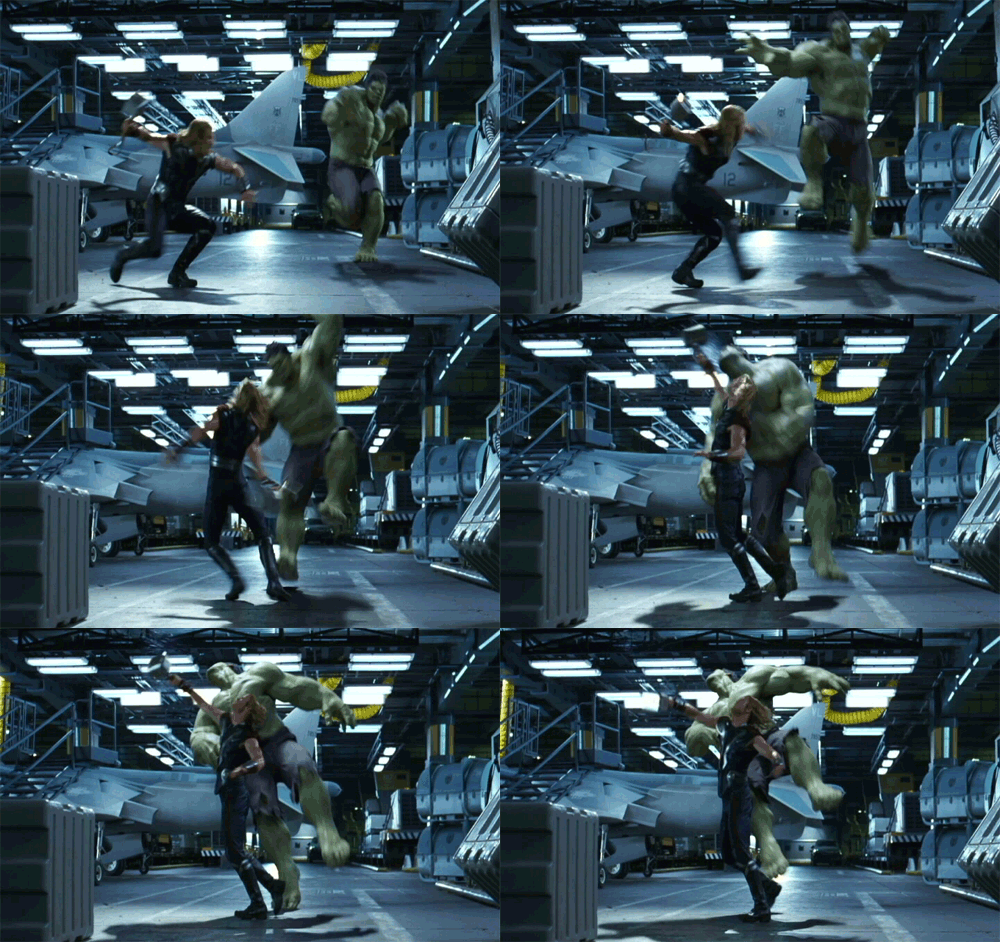
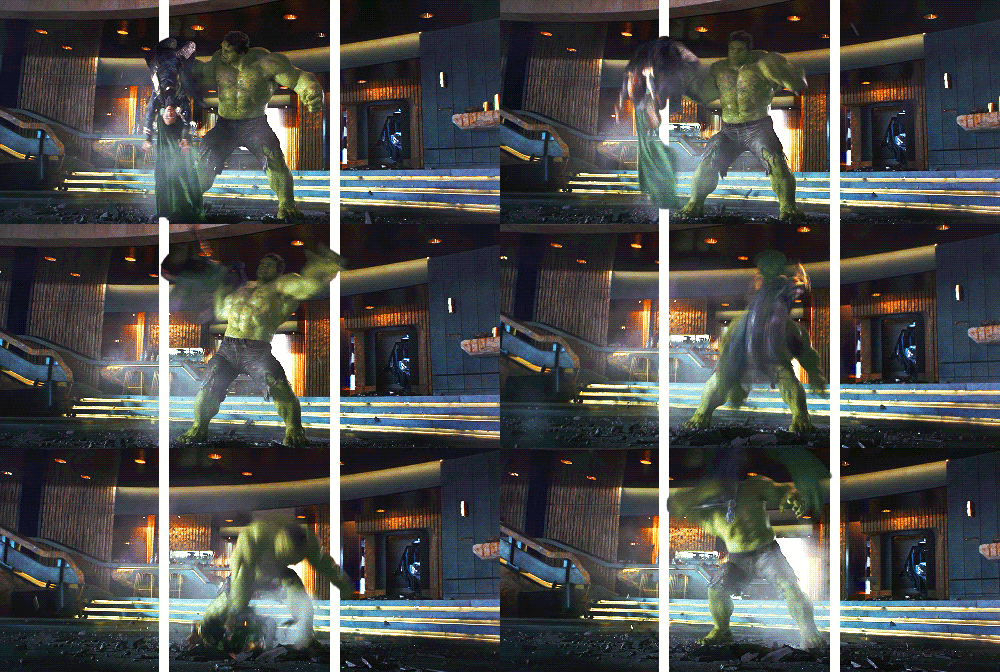
As Black Widow interrogates Loki, we learn that she has a salty past, and owes Barton her life, so she is intent on getting him back on the right side.  We are also given a fairly useless red herring, as Loki leads her to believe that the he was captured on purpose, and that the Hulk is somehow going to be Loki’s maguffin to harness the power of the Tessaract.  It’s really all an elaborate set-up to get Banner to turn into the Hulk just as Loki’s forces attack the heli-carrier to rescue their leader, and chaos ensues.  I may have missed some of the details, but the whole Hulk/Power source storyline seemingly went nowhere, as it turns out Loki was really just pulling strings to get the Hulk running loose in SHIELD headquarters because he wanted to see the fight between his brother and ol’ Green-skin. Guess he doesn’t have much faith in his own troops, but it did make for an awesome sequence.

8177

Anywho, Loki escapes (even though there was no real reason for him to be there, anyway), Agent Coulson is killed, and the Avengers are scattered in the wind.

Fury then rather callously uses Agent Coulson’s death at Loki’s hands as inspiration to help the Avengers to look past their petty differences and stop Loki. With the help of now-good-again Agent “Hawkeye” Barton, they go to New York, because Loki is going to use Tony Stark’s new repulsor-powered skyscraper as a conduit to get The Tessaract to open a doorway for an alien invasion of Earth. I don’t know what purpose the building serves, either, but it looks cool.

So, it is six Avengers against an entire alien army in the final battle, and the good guys finally learn to work together to save their planet. Captain America uses his leadership skills to help bring them together, and gives the coolest line of the movie when, while barking orders to everyone, looks at the Hulk and simply tells him to, “Smash.” Oddly enough, minutes before, we also got the movie’s most-unintentionally funny line, when Bruce Banner shows up seemingly out of nowhere on a moped and mentions that this alien invasion thing is “pretty horrible.” A deleted scene reveals that he landed in Jersey, saw the aliens attacking New York, and was given the moped by Harry Dean Stanton so he could make it there and help fight the bad guys. I get that the movie may have flowed better without it, but it did seem weird that Hulk just kind of showed up out of nowhere. Oh well. He did beat up a lot of bad guys.

Here’s the funny part about this movie. Despite being horribly out-numbered, I never doubted for a minute that the Avengers would come out on top in this one. And of course the good guys were always going to win, but even within the reality of the movie, I don’t think the outcome was ever in doubt. Because Loki was the only real villain, and the rest of them were faceless drones, it would have seemed odd if Captain America was murdered by one of them. As I’ve said a million times, it is the writer’s job to convince the audience that there are real stakes here, and yes, an alien invasion should make for high stakes, but come on, “They have a Hulk.” The aliens never really had much of a chance.

tumblr_ms82x15GBD1sbhkw0o3_500

Still, how do you wipe out thousands of aliens when you only have six heroes? Why, the Phantom Menace ending, of course. You blow up their ship and they’ll all die for no reason. The good news is that there was a nuclear missile at play for just that task. The testy members of the World Security Council that order Nick Fury around decided that New York was a lost cause and the only way to nip this alien invasion thing in the bud was nuke the whole city. Fortunately, Iron Man was able to grab the nuke, fly it into the Tessaract-created portal, shoot it at the alien ship, and fall through the portal seconds before Black Widow used Loki’s own mind-controlling staff to close the portal up for good. Whew. That was a lot of stuff at the end there. Maybe there were high stakes.

The point of it all is teamwork. To further illustrate what a great team they are, most of them go their separate ways at the end. Thor takes Loki back to Asgard to face judgment. Tony Stark and Bruce Banner take off for the ultimate Bromance vacation. Black Widow, Hawkeye and Captain America are stuck working for Shield, even though Cap complained about their duplicity for most of the movie. However, according to Nick Fury, the team will be there if the Earth needs it, which will be at least three more movies.

I know there’s a lot of snark here, but to be perfectly honest, The Avengers is a very watchable movie. It has foibles, but what movie doesn’t? As I said in the first paragraph, it is sometimes good to see how a movie settles, and this one settles very well. There are obviously no perfect movies out there, but this one does its job. It entertained a lot of people, myself included, enough to be excited for the second one, and that’s really all that anyone can ask.

With the not-awaited-at-all news that there will soon be a third installment in the Tron saga, I figured I would revisit my blog post from 2010 after seeing Tron: Legacy. I updated it a little, so it wouldn’t seem like just a retread, which is what I was kind of hoping for from the movie itself. Anyway, here goes:

tron-3-trailer

——————————————————————————————————————————————————-

Things were different back then. It was 1982.  Atari 2600 was the rage.  There was trouble in the Middle East.  Coke vs. Pepsi was a big debate, as was coke vs. heroin.  I was six years-old, and I was mesmerized by Disney’s Tron. Well, admittedly, I was mesmerized by the blue and red light bulbs that people seemed to be wearing and the really cool light-cycles.  The rest of it went way over my head. But I still loved the movie.

My, my, how things have changed. Or not. Sure, Atari is not the rage anymore, but I pretty much use current technology exclusively just to play those old games.  There’s still trouble in the Middle East.  And Tron: Legacy was cool for the light-cycles and the rest pretty much baffled me.  For example, this question continues to plague me: was Jeff Bridges trying to recreate The Dude from The Big Lebowski or is that just the way he acts nowadays in every role?*

tron-legacy-lebowski

I have been trying to be less critical of movies as I get older, and I think overall I’ve done well (and I think actually seeing fewer movies helps), so when I first heard that they were doing a sequel to Tron, my first instinct was, “Another silly re-tread? Forget it.”  Then I saw some trailers, and I thought it looked pretty cool and figured it was worth my time.

Remember, kids; always trust your instincts.

“But, Durs, didn’t it look cool?” you may be thinking.  And, sure, the light-cycles, the Matrix-esque fighting with glowing frisbees, and the return of the big horse-shoe ships were all very fun.  But we have video games for that kind of thing.  Come on, including the 3-D glasses, do you want to spend $13 on a couple of minor aspects of a movie?  The rest of it was just a lot of talking about things that actually don’t exist (also similar to The Matrix, only without the crappy philosophy and Keanu Reeves looking dumb and constantly asking, “What?”), and I’m not sure why we should care what happens in the “Tron World” for that very reason: it doesn’t actually exist.  What are the stakes except that The Dude may not survive long enough to drink another White Russian?  And, sure, there are movies with less at stake.  Weekend at Bernie’s, for one.  But the job of the screenwriter is to make the audience care about these things.  If you can convince the audience that saving the “Tron World” is important, then you have accomplished something as a screenwriter. For example, I have never personally traveled through time, but I understand why Marty and Doc had to succeed in Back to the Future. It’s all about stakes. Tron: Legacy front-loaded all the cool stuff in the first 45 minutes or so, then spent a loooooong time explaining why it all happened. And over a very visually-exciting dinner, no less. However, I never got an explanation on why it mattered. Apparently, the bad guys were going to invade the real world somehow, but whatever…

In Tron: Legacy, Sam Flynn (Son of Dude) gets a strange “page” from his father’s arcade, and assumes it is from his old man who disappeared twenty years ago. Sam investigates and is pulled him into the same Tron World where Kevin “Dude” Flynn has been hanging out for the last two decades, apparently getting really high. When father and son reunite, they (along with the oddly-named Quorra) embark on a quest to stop this big bad guy of Tron world, who was apparently created by Kevin somehow. Why he created bad guys I can’t recall, but I’m sure the movie explained it. And I’m sure the explanation was convoluted and took forever. There was something about a CLU and and a program that looked like Kevin  (Two Dudes!), but honestly I just wanted to see the life-cycles. The plot was not really important, and this is one of the few times where I can honestly say that. I actually don’t even remember how it ended, so… NO SPOILERS HERE!

I think I know the thinking behind this sequel. Much like the Wall Street sequel coming on the heels of some economic turmoil, the folks at Disney probably thought that since we are in this digital age, the time was ripe for a Tron sequel.  They maybe thought the whole Grid thing and all of us essentially being Programs or Users these days would lend itself to the story of Tron, even 30 years later.  Sadly, that is not the case.  Despite my Atari reference earlier, it’s a much different world now.  The games we play on our phones are better than the original Tron special effects, which were done mostly with paint and canvas, by the way.  For all that talk about Tron being the first movie to use CGI, only about 15 minutes of the film are computer animated, because the technology didn’t exist yet to combine digital animation with real-life characters.  Not to mention that that the computers they used actually had only 2 MB of memory. So, basically calculators.  I think there’s more than that in a pen these days. There have even been huge advances since Tron: Legacy was released in 2010. We can now track our pizza order online through its entire creation, down to the placement of every pepperoni. That may actually have light-cycles beat.

maxresdefault

Point is, our standards for what is cool and what technology can and should do have changed.  I’m not sure lighty frisbees cut it anymore.  To paraphrase Ian Malcolm, and a franchise that hopefully gets its re-launch right; it seems to me that these people were so concerned about whether or not they could make a better Tron movie, that they didn’t stop to think if they should (or, y’know, write a decent script.) We have conquered the digital frontier already, Dude. I don’t think we need to hear about it again (and apparently, again, Tron 3).  If I’m interested in a history lesson, I’ll just watch the original Tron.

* – This is one element that is a little dated since 2010, because it has been proven that, in fact, that is how Jeff Bridges acts nowadays.

With Zack Snyder becoming a comic movie “icon” after directing Man of Steel and soon-to-direct Batman vs. Superman, I decided to turn back the clock and cover his first notable comic movie adaptation. Remember this one? Sure ya do!

—————————————————————————————————————————————

I think that my original opinion of Watchmen was formed before even walking into the theater. And I don’t mean that in the usual sense, like I watched the trailers and read a little about it and decided if I would like it or not. What I mean is I read the source material, and been following all the build-up, and was fairly certain, based on the reaction of the “nerd community,” that this was going to be a big one. Like, lines around the corner and sold-out shows big. People dressed up like Rorschach big. All that does start to inform my opinion of a movie, whether I like it or not.

None of that really happened, though.  In fact, friend and fellow-podcaster Josh and I walked up, picked up our pre-ordered tickets, bought popcorn and soda, walked into a modestly-filled theater and sat down and watched the movie.  That was it.  No throngs.  No Rorschachs.  Nothing.  The damn thing wasn’t even sold out on opening night in Boston.  What happened?  Did they open it on too many screens?  It apparently earned $25.1 million in one day, so it may not break any records, but that’s more than a lot of films make in weeks.  Did everyone go at midnight?  For the first time in my life, I was disappointed not to see fanboys.

However, despite what I said earlier, I tried not to let that hamper my enjoyment.  Let me discuss the movie itself.  It centers around a group of former super-heroes called The Watchmen,  who had fought against the forces of evil decades before, but had now settled into retirement and (in the original comic book, anyway) gotten sort of flabby.

3824850-9525840093-niteow

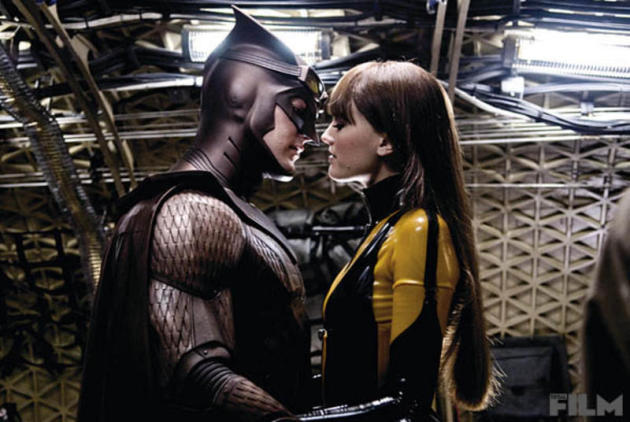
When one of them, The Comedian, is murdered, do-gooding loony Rorscharch believes that someone is hunting down the ex-heroes.  He looks up his old buddy Nite Owl to ask for help, but Owl doesn’t seem interested in a reunion with his smelly former colleague (because he’s flabby, although Zack Snyder apparently doesn’t allow flabby heroes in his movies, even when it is part of the plot.)  He does become interested, however, in a reunion with Laurie Jupiter, who served in the Watchmen as Silk Spectre II (played by the decidedly not-flabby Malin Ackerman), following in the footsteps of her now-busted mother, the aptly-named Silk Spectre I.  Despite the fact that Laurie is now married to the all-powerful, all-naked, Dr. Manhattan, she seems unhappy with his growing detachment, and Owl pursues her vigorously.  Meanwhile, no one believes Rorscharch is anything but a kook.  Eventually, the poor guy is arrested and not one of his former friends seems to care.

At some point in there, Nite Owl tires of his boring life and he seeks out ladyfriend Laurie, who is now estranged from Dr. Manhattan, because he had a bit of a hippy freak-out over nuclear weapons. Even though Owl is clearly in the friend-zone, they inexplicably decide to don their costumes again and go stop some ne’er-do-wells. They quickly determine that super-hero-ing is a major turn-on, and they fornicate in costume (well, mostly) inside Owl’s weird “bat-wing” flying machine.  Post-coital and still half-naked, they decide, rather suddenly, to free old teammate Rorscharch from the asylum where he has been rotting for half the movie, even though they seemed to not care at all when he was arrested. Seriously, they literally say, “Let’s go bust out Rorschach.”  Sex changes everything, I guess, and apparently it does so in a matter of moments.

nite-owl-and-silk-spectre

The reunited Watchmen figure out that The Comedian’s murder was the work of Ozymodias, another former ally who has become a multi-millionaire jerk since leaving the group, and band together to go kick his ass.  Somewhere in there, Dr. Manhattan decides that the human race is worth saving even though we developed nuclear weapons, and comes back to help save the world.  Yeah, it gets messy from there.

I’ll say it right here, though: I enjoyed most of Watchmen.  I mean, sex, violence, super-heroes…  What’s not to love, really, other than Billy Crudup’s little blue Crudup every five seconds?  There were obviously some problems, and a lot of fans disliked the changes made for the film version.  Personally, I was not a gigantic fan of the comic anyway, so I didn’t really care that anything was changed.  In fact, I’m not quite sure I understood what was going on by the end of the movie, anyway, and I’m not sure I really cared all that much.  I just sat there with my popcorn and watched the pretty people have sex and beat on each other.  Not the best script certainly, and the acting was really stiff, but I’m trying to be better about these things, and it was certainly a technical marvel that will undoubtedly murder people on IMAX. The problem is, that can describe most movies nowadays, so I need something more. This movie, while there was nothing greatly wrong with it, needed to be more, since it is such a beloved story in the minds of comic fans. Watchmen didn’t have a lot wrong with it, but it didn’t have much right, either. It’s very much a movie not to care about.

My biggest complaint is the pacing of the story.  By the time I got there early, sat through commercials, and previews, and the warnings to turn off my cellphone, then the little thing called the-reason-I-went-there-in-the-first-place, I was into this thing for well over three hours.  Anything you invest that kind of time in better be amazing, so that’s why my review is rather mixed.  Honestly, there are very few things I want to do for three hours straight, and sitting in a dark room is not one of them.  Even if you go to a baseball game that will probably last about the same amount of time, you get to get up and get a beer, talk to the person next to you, throw things at the players.  All of the sudden, it’s the 7th inning stretch.  Sitting through a three-hour epic comic book movie?  Not quite the same thing.  All of the sudden, I looked up and they were still developing Dr. Manhattan’s character.  I know that’s important and all, but there was about a 45-minute stretch there in the middle where Rorschach and Nite Owl weren’t even in the damn thing, and I kind of thought they were the main characters.  Don’t you think it would have been possible to get those “Dr. Manhattan on Mars” scenes over in about ten minutes and get on with the actual plot (and see less of his blue dick)?  My screenwriting profs always taught me to “Get in and get out” when it came to developing your story.  Why did we have to see him looking at a clock for all that time?  To further drive home the point that this a long-ass movie?

Don’t let me poop on the parade, though.  Overall, I think it was a decent movie.  My friend John may have put it best when he said it was “better than Indy 4 but not as good as Dark Knight.”  While that is a pretty wide open field, I think in the annals of comic book adaptations, if Watchmen is remembered at all, that is where it (and most movies) will end up.  I will also say, however, that IMAX (still new when it was released) probably helped this film immensely because IMAX platters needed films to be a shorter running time (about 150 minutes) to accommodate the projectors.  This necessitated some trimming, unless they just want to show the regular old movie on a really huge screen.  This trimming of the fat I’m sure helped the movie flow better, and probably gave crumb-bums like me less to complain about. I wouldn’t know because I never bothered to see it again. No need to, really.

In the end, it’s a comic book adaptation, and not to be poured over too much.  Still, unlike a Spider-Man or Batman movie, which is based on a character doing his or her thing, Watchmen is based on an actual story, more like a movie adapted from a novel. Like most movies based on previously-published novels and stories, it is not as riveting as the original work, nor as deep or as ground-breaking.  But, in the end, it is worth seeing.  My advice would be to get yourself a nice, big bag of popcorn and hunker down and watch the Watchmen do their thing, and when it’s over, move on with your life.  And if you’re looking to cut down the running time, simply skip the blue full-frontal.  It’s not necessary.  Ever.

drmanhattan

With the news that Spider-Man will now be swinging over to the Marvel Cinematic Universe, I thought it would be a good time to dust off my review of Amazing Spider-man from a few years ago. I never did make it a point to see The Amazing Spider-Man 2, and after you read the review you’ll see why. See despite the fact that I am a comic-book/super-hero movie enthusiast, I can’t say I’m “all in,” because when a movie looks that bad, I can’t waste my money. But, as every movie must exist on its own, here was my take on The Amazing Spider-Man.

First off all, I may have gone in with the wrong attitude, because I was not impressed with the trailers, the preview footage, the leaked footage, the cast, the villain, or the very idea that this franchise needed to be re-booted in the first place. So, what does that leave me with? Probably not a lot, but with such low expectations, there’s a chance I could be surprised, right?

Well, that didn’t happen, unfortunately, but rather than turn this into another “bitching” post, I want to get into the whys and wherefores, because it took me a little while even to figure out why this movie was so unimpressive to me. Honestly, the changes to Spidey’s costume didn’t bother me, and in fact, it looked kind of cool. And the other changes from the Sam Raimi-Tobey Maguire version were fine as well. The fact that Peter was able to make his own mechanical web-shooters, complete with webbing, was a nicer touch than having the webs inexplicably shoot out of his wrists (and more like the actual comic book character.) As my friend, Jay, pointed out in 2002 when the original Spider-Man was released, “If they wanted to make it more realistic, shouldn’t the webs shoot out of his ass?”

And the change from Mary Jane to the much-beloved Gwen Stacy (played by the much-beloved though slightly-too-old-for-high-school Emma Stone) was an improvement as well. I always liked Mary Jane better in the comic, but Kirsten Dunst just never had any pizazz. Emma Stone and Andrew Garfield did have some chemistry, probably because they were dating in real life. And obviously, though it still has its faults, CGI has come a long way since 2002, so Spider-Man swinging through the city looks slightly better, especially that one POV shot where you could see his hands firing the webs and them catching on to buildings, so we get a sense of what it’s like. Ah, video games at work. Also, sometimes in those Raimi version of old, it looked like the webs were catching on to clouds, because he was way above the buildings in some of those shots.

That’s about where the praise ends. For me, that’s actually pretty good, but something about this movie made it more than just bad. It was somehow annoyingly bad. Maybe because I had such a love for the character. Maybe because I didn’t see the need for a re-boot after only a few years since Spider-Man 3, although that movie was pretty terrible, too, so the studio was probably just trying to help us forget that ever happened. But the real reason I found this movie annoying was because deep down I knew that Sony was only doing this one because if they sat on the property any longer, the rights would revert back to Marvel, meaning Disney would get their hands on this money-maker.

Or maybe because Andrew Garfield kind of sucks. (Note: He has apparently spun his last brooding, grumpy web, as the Marvel suits will be replacing him.) For one, he’s too good-looking to play nerdy Peter Parker, and any comic book fan knows that the real judge of an actor playing a super-hero is that you have to be able to play the alter ego (see: Stark, Tony). But not only was he just not right for this part, I have never been impressed with his work, period. Between The Social Network and The Imaginarium of Dr. Parnassus, and now this, the guy is 0 for 3 in my book. Not that he had a lot to work with here, but he just wasn’t nerdy enough or cool enough to make me believe in him, as Spider-Man or Peter Parker. He seemed to just be saying the lines of dialogue fed to him like he was in some high school play and he was getting extra credit or something. I never got that he mourned his uncle, or that he cared for his aunt, or that he felt any obligation to be a hero. As I said, the only decent scenes were between him and Stone, and I don’t know if that’s because they are dating, because she’s actually pretty decent (and hot!), or because director Marc Webb (whose previous credit was (500) Days Of Summer, which was a brilliant rom-com) has some experience with on-screen chemistry.

images

Beyond Garfield’s performance, the movie itself lacked a lot of the drama inherent in even the comic book. For example, in the comic book, Peter has already become the Amazing Spider-Man, and is putting on regular TV appearances when he allows the criminal who eventually kills his uncle to escape, so the guilt is more obvious because Peter was using his powers for profit. That’s where the whole ‘Great power, great responsibility” line, which is in just about every Spider-Man comic ever written, comes from. Why take out that whole dilemma and replace it with a fight with a convenience store clerk over chocolate milk, which leads to his uncle’s murder? Not to mention that the scene in the Sam Raimi version where Peter is wrestling is one of the best in the whole franchise, featuring not only the great Bruce Campbell, but the dearly-departed Randy “Macho Man” Savage.

spider-man-05

(Incidentally, not to spoil the movie for anyone, but did he ever catch his uncle’s killer? Did we ever get that “Aha!” moment when he discovers his blunder and decides to become a crime-fighter?)

When they do bring some drama into the movie, it’s too ham-fisted to matter, like the scene near the climax where several crane operators are called in to give Spidey (who has saved exactly one kid in the movie at this point) something to web onto as he rushes to fight The Lizard and save the city. I’m still not sure how those crane operators knew he needed that boost, but whatever. And why weren’t they all, “Why’s that dude wearing red-and-blue underwear?”

I realize that this is just one bad movie among hundreds, but this one instills a fear in me. Tobey Maguire, who, despite his faults, was a great Peter Parker, was replaced after three movies because they wanted a younger guy to appeal to the Twilight audience. Will Tony Stark receive the same treatment in a couple years, despite the fact that Robert Downey, Jr, is Tony Stark? Will Thor get re-cast as some young meathead in a few years time? Will The Avengers simply get re-booted every few years with different people just to attract the next generation?

In the era of re-boots, re-makes and re-imagings, I fear the answer is yes.

Recently, I watched 9, the Tim Burton-produced vehicle about odd-looking burlap dolls saving the planet from… whatever the Hell it was that had taken over the planet.  It’s only been a few days, but I can barely remember the thing at all.  All I seem to remember is that the main character (Doll #9) was attempting to save his fellow dolls’ souls that were trapped in this machine, and at the end, the dolls were still dead.  I guess I thought saving them would involve actually saving them.  That’s why I’m a soulless bastard.

More than the movie itself, which was obviously not memorable at all, I remember the conversation I had with my fellow 9-ers after the movie. I saw it with some friends of mine, and one of these friends (who is much more optimistic and jolly than I) said that he likes movies because life is just too darn hard not to. He loved the live-action Transformersmovies for the simple reason that he wanted to see stuff blow up (and Michael Bay movies occasionally feature such things.) Honestly, I cannot fault his logic.  Movies are supposed to be an escape from the drudgery of everyday life.  However, must we sacrifice quality for explosions?
I pointed out to my friend that J.J. Abrams’ Star Trek re-make/re-boot/re-imagining had plenty of action, and a few explosions, and was an excellent movie.  Far better, in fact, than anything Michael Bay has ever directed.  He concurred, yet was not swayed from enjoying Transformers.  Which is good, because for whatever reason, I have a tendency to try and convince people that they are wrong and whatever movie they like and I despise is, in fact, terrible, so I applaud him for sticking to his giant, pointless guns.

We live in curious times as far as our entertainment goes. We may forget that movies, as we know them, have not been around all that long, and yet there are so many of them that the audience takes good movies for granted and now just wants to be mildly amused for a couple hours. Plots, themes, being amazed by the special effects, these are all lost amid giant, fighting, CGI-robots who are mostly indiscernible from each other, and super-heroes who seemingly have to suffer emotional strife, yet always manage to defeat the villain and get the girl at the end. Of course, people like my friend will try to convince me that, sure, the story sucked, but those CGI effects in Transformers were really awesome. Well, of course they were. They were all done by computer programs that anyone can purchase on the internet.  To me, knowing that, if I had the time and money, I could do the same thing takes a little of the magic away.

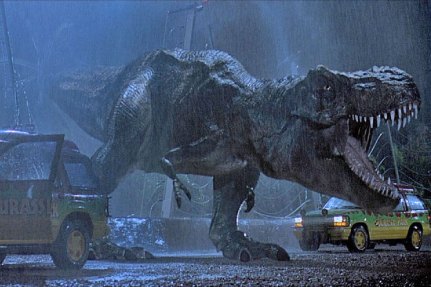
This is why Jurassic Park is still one of my all-time favorite movies.18jyfksl1kks0jpgThere was still an element of “How did they do that?” when it came to the dinosaurs.  The special effects wizards behind the Raptors and T-Rexes combined elements of CGI and animtronics to create creatures that actually looked real because they were. And this is 1993-CGI, so basically, the computers they used to make it were probably a few steps behind today’s smartphones. The techno-dinosaurs in the movie had weight and dimension, things that no Transformer has.  That logic, to me, also applies to the story.  A man is breeding his own dinosaurs, opening up a big can of worms (the morality, the idea that they are selling this scientific boon that could probably used for more noble means.  Or as Jeff Goldblum’s Ian Malcolm adequately puts it, “What you call discovery, I call the rape of the natural world.”) Jurassic Park takes the first half-hour introducing the premise and developing the human characters before we even see a dinosaur.  That is why the story has as much weight as the dinosaurs. Transformers didn’t waste a whole lot of time developing Shia LeBouf or Megan Fox (not that she needs much developing). As I recall, the robots landed and the chaos ensued. It’s similar to Spielberg’s other scary-creature epic, Jaws. We don’t see the shark, mostly because of the technological limitations, but we know he’s there eating people, and it gives us time to see how Roy Schieder and Richard Dreyfuss, and thankfully, Robert Shaw, deal with it.

With Jurassic World possibly set to ignite the franchise again this year, I thought it would be a good time to remember the original. I’m sure everyone remembers the story. Stereotypical Eccentric- Rich-Old-Dude John Hammond wants to create a theme park/zoo hybrid when he buys the technology to engineer his very own dinosaurs and market them to the public. Unfortunately, his investors require a couple of top notch brains to sign off on the park to make it a reality. He brings in two paleontologists, played by Laura Dern and Sam Neill, and whacky “chao-tician” Ian Malcolm, played by Jeff Goldblum. During their tour of the island, scummy bad guy Dennis Nadry (Wayne Knight) tries to steal the park’s secrets and dino- DNA, and his evil machinations send the park into disarray, releasing the dinosaurs and creating what amount some really cool action scenes involving dinosaurs attacking people.

When thinking back on this movie, I try to forget about the disappointing sequels. I find it best to remember my excitement back in 1993 with the idea that there would be dinosaurs on the big screen (I was a big fan!) Back then, we had seen a lot of stuff in movies, but seeing real-looking dinosaurs was about as rare as seeing a real dinosaur. It didn’t matter that Goldblum was the biggest name actor in the cast, because the dinosaurs were the real stars.

And they delivered. But while all the dinos were amazing technological marvels, it was the Velociraptors that stole the show. Sure that T-Rex scene was cool, and eating the lawyer off the toilet was just awesome, the raptors , a dinosaur I had never even heard of before that, were the baddies that really gave me chills. They can smell fear. They can hunt in tandem. They can open doors! No Great White can do that. It was all the humans could do to simply not die (although a bunch of them did, which did help raise the stakes a little.)

Speaking of which, I have always felt a little cheated when movies end with the main characters attaining victory by surviving, as opposed to actually defeating the bad guy. I never cared for those disaster flicks because the entire premise is simply not to die by the time the credits roll. Jurassic Park is the exception that proves the rule, because there is simply no way those lame humans, and especially those kids, were going to kill all those dinosaurs. However, the finale is no-less satisfying because just when you think that the raptors are going to devour our heroes, the big, bad T-Rex returns, attacking the raptors to claim the title of Dinosaur World Heavyweight Champion. This action only serves to underscore the earlier assertions that not only are dinosaurs and humans not meant to live together in harmony, but dinosaurs aren’t even meant to live together. They cannot be controlled, and the T-Rex makes sure everyone knows that, throwing a raptor’s carcass through the man-made T-Rex skeleton to complete the awesome imagery. Plus, if they killed all the dinos, there would have been no sequels. Although that may not have been so bad…

However, this is about the original film, a ground-breaking achievement for its time. I still assert that the dinosaurs in Jurassic Park look more realistic than any alien in the Star Wars prequels, or anything in any Transformers movie, mostly because they mostly were real, or at least tangible. We shall see how tangible the dinosaurs of Jurassic World are 22-years later, but my memories of the original are as tangible as ever.

eZJIgZN

Bloggers Note: My buddies Claynferno and John Hunt used to joke that they could tell whether or not I was enjoying a movie-going experience by my reaction, saying that if I spent most of the movie “fidgeting and sighing,” then it wasn’t a very good one. So, I thought it would be a fun idea to compile some of my feelings on my favorite genre of movie, the comic book movie, into some blog posts. And once I get thousands of hits and followers, I would eventually turn them into a best-selling book. Right?

Anyway, here’s my first post of Fidgeting and Sighing for your reading pleasure:

———————————————————————————————————————————————

Not every hero’s journey can fit nicely onto a two-hour movie.  Occasionally, you come across a hero that does not necessarily translate to a mainstream audience.  Being a fan of comics requires a certain suspension of disbelief, so to try and feed certain characters to a mainstream audience, tell their origin and the origin of their nemesis in a small window and expect to tell a good story on top of it is sometimes asking a lot.  Jean Grey morphing into the Phoenix in X-Men 3 was one example.  A classic, year-long comic book epic simply did not fly in the movie.  Basically, she was a pretty nice person up until she was inexplicably resurrected, and then suddenly her face got craggy and she decided to kill her boyfriend (off-screen, no less!) and her mentor and turn into a real rotter.  For no reason other than she was a powerful mutant.  At least, that’s all we were told as a movie-going audience.  Granted, the filmmakers didn’t have time to send the X-Men into space so Jean can sacrifice herself to save them only to actually be kidnapped, replicated and put into suspended animation for a decade, but still,… those chumps took the easy road.

Green Lantern is another such example.  While he is a beloved comic character with decades of history, by the time the technology existed where it could be done right, and the demand for comic book movies reached a level where it mattered, the studio was so gung-ho for a Green Lantern film that apparently no one bothered to read the script.  The comic book movies that make boatloads of money do so because they seemingly take place in the “real world.”  The audience is supposed to believe that any high school kid (or even themselves) could have been bitten by that radioactive spider and gained super-powers.  Or that there is a dark knight patrolling the streets protecting us from evil while we sleep.  A good writer will be able to put the audience in the story somehow, otherwise there is no emotional attachment and the audience might as well be watching The News.  A competent writer realizes that just because no one has ever travelled through time does not mean that Back to the Future is not a compelling movie.

NOV140894

Unfortunately, Green Lantern is not compelling in the least.  The idea that a huge cadre of warriors exists and that each protect their own corner of the universe is maybe just a little too far-fetched for a mass audience, and these writers don’t do their job of selling it to them.  It’s silly enough as a comic book.  To try and tell the story of Hal Jordan (played by Ryan Reynolds), bumbling test-pilot, in a couple of hours is hard enough, but when you toss in the fact that he is chosen by an ancient green, power ring to protect this sector of the universe from all manner of evil, that he has to learn to use said ring’s power, impress Blake Lively, defeat the bad guy, and still remain witty Hal Jordan is a lot of crap to squeeze into a screenplay.  This is why comics have story arcs.

Speaking of Blake Lively, she plays Jordan’s love interest, Carol Farris.  Like most comic book movie love interests (Kirsten Dunst, Katie Holmes), she could be a potted plant.  She only exists to look nice and for the hero to have someone to save at the end.  Reynolds himself isn’t much more significant, because his job is basically to look nice in his green spandex (including those icky toe-shoes) and looked awe-struck when light-structures come out of his ring.  It’s not entirely his fault because he has very little to work with here, but this is also what happens when you take guys who should primarily be in romantic comedies and cast them in comic book movies.  This is why Hugh Grant will never play a super-hero.  Obviously, I don’t blame Ryan Reynolds for getting the big payday, but “cashing a paycheck” does not even begin to describe his rigid performance.

Screen-shot-2011-04-12-at-3.05.38-PM

Still, despite being hand-cuffed by such a bizarre concept, a good writer might have been able to salvage something (Thor is an out-there concept, but they made a decent movie out of that.)  Certainly not something Oscar-worthy, but at the very least likable.  The film doesn’t do itself any favors by being a pretty ridiculous movie on top of having a concept that is hard to swallow (not to mention follow.)  Once Jordan learns how his power ring works, he begins to use it to create objects.  In this vein, he is at the mercy of his special effects artists.  For example, to save his beloved Blake from impending disaster in a falling helicopter, he decides, within seconds, to use his ring to create a giant slide to get it safely on the ground.  Well, “safely” is a relative term.  The chopper still kind of crashes, it just does so more spectacularly and doesn’t actually kill anyone.  Relating this incident to what was said earlier about making the audience believe this stuff could happen, I would like to think that the “real” Green Lantern would create something a little more practical to catch a falling helicopter.  Say, a net.  Practical, maybe, but not nearly as cool to render in CGI.

Still, a less-picky, and less-fidgety, audience member would probably be willing to over-look such weaknesses in writing if the movie possessed other qualities.  It does not.  The acting is painfully stiff.  The story is weak, and the special effects aren’t even all that special.  The final showdown between Green Lantern and his arch-nemesis, the bubbly-faced alien, Parallax, typifies the general feel of the movie, as GL declares that the only way he is going to win this fight is to “out-think” his opponent.  He then proceeds to create a green Gatling gun to blow him away.  Not exactly a good message for the kids.  Good thing none of them saw it.

Green Lantern suffers from the same affliction as many of its contemporaries; just because a filmmaker can do something does not mean he necessarily should.  You would think that through the miracle of CGI, a screenwriter would only be restrained by their own imagination and that it would be easy to write in anything they want and it would come up roses.  In fact, often the opposite is true.  Just because the CGI experts have the ability to create a giant slide does not necessarily mean that they should, if it doesn’t serve any real purpose in the movie.  The limitless possibilities have instead made some writers lazy, especially when it comes to the very basics of story-telling.  Why does Hal Jordan say he must out-think his adversary, only to then blow him away instead?  There is no earthly reason.  It’s just bad writing.

Let me put it this way; they still teach Tootsie in screenwriting classes because of the structure, not because Dustin Hoffman looks good in a dress.

About 4 million years ago (give or take), I used Kickstarter to fund a little comic book I had written. It was a sort of retroactive funding, since I had already paid for most of the artwork on the thing, but still a much-needed boost, because I soon learned that creating your own comic when no one knows who you are is not a get-rich-quick endeavor. Or a get-rich-at-all one.

Anyway, I paid all the collaborators and printed a couple hundred issues, some as rewards for the donors and some because I had this silly notion that people might actually buy them at conventions and things. But the goal all along was to get on Comixology.com, pretty much the biggest dog in the world of digital comics. They carry Marvel, DC, Image, Dark Horse, and even a have small section for little weenies like me called Comixology Submit. The great thing about this business model is that there are no printing costs. Comixology takes a percentage of each sale (if I actually sell any), but otherwise I take home the rest.

Now, technically, the book is already available on several websites, including Amazon, Indyplanet and even a little place I found called Robinhoodcomic.com (which, of course, I only recently discovered had a broken shopping cart link. Sorry, folks. It’s totally working now, by the way, in case you’re interested.) However, I have all of .69 cents in my Indyplanet account, and have made three whole bucks from Amazon digital sales. Remember what I said earlier about the “big dog?” That wasn’t idle chatter.

So, I submitted to Comixology some time ago, and was delighted when I received an email stating that the book had been accepted… kind of. I had a few technical corrections to make first. Apparently, the problem was something the Comixology people called “artifacting.” Naturally, as I typed that, there is a red, squiggly line under that word, because it doesn’t actually exist. I asked several graphic designer friends, and people in comics, and Google, and finally figured out what the issue was. I thought I had fixed the problem and submitted again, only to receive the exact same email from Comixology telling me that that there was a problem with “artifacting.” After exhausting all of my friends, both computer-y smart and creative, and three attempts, which were all separated by about three months of waiting for a response, I got the email officially congratulating me and saying that my book was going to be carried on Comixology, starting December 31st.

I don’t know if this date is cool foreshadowing for 2015, or an amazing coincidence, but either way, it’s good news. This idea that I started way back when now seems more official. Not that it wasn’t “official” before, but to me, it seems nice and real now, mostly because I am my own harshest critic. It also means I actually have to come through with issue #2 now.

If you made it this far into the post, you obviously have some interest, so let me apologize to you,loyal friends and colleagues, because starting at 10:00 a.m., December 31st (tomorrow, as I write this), I am going to bombard all of you on social media with links and shares and tweets and smoke signals, reminding you that this is a thing and that it’s a cool book and you should buy it, and if you don’t want to buy it (which is understandable), you should at least tell your friends and your friends-of-friends. Because let’s face it, that’s how this shit works these days. And thank God, because I wouldn’t be here, otherwise.

Thanks in advance, and happy New Year!

I recently got “Hip To Be Square” by Huey Lewis & the News stuck in my head. For some reason, I started to think a little about the lyrics, and got inspired to write about it. So, here goes:

First, a little paragraph for the background of the song: it was the second single off of the band’s multi-platinum album Fore!, released in 1986, and was written by drummer Bill Gibson, keyboardist Sean Hopper and Lewis himself, so it wasn’t like some guy in a board room wrote it for them. It reached #1 on Billboard’s Album Rock Tracks, and 3 on their Top 100 list. Now, I won’t even pretend to really know what all that means, but in 1986, it’s safe to say that it was pretty popular.

Still, that was almost three decades ago, so it’s also safe to say that almost anyone who knows the song at all these days and is under the age of 35 only knows it from the famous scene in American Psycho. For those of you who are not familiar with the scene, it’s the one where Christian Bale recites a sermon about “Hip to be Square” being Huey’s “undisputed masterpiece” just before brutally murdering Jared Leto with an ax, screaming “Try getting a table at Dorsia now you $%#&-ing, stupid bastard!” It’s actually quite hilarious. I remember seeing the movie in the theater during it’s initial run, and being slightly disturbed, but appreciating the message. In the years since, I feel the movie (and I guess, by proxy, the song) has garnered a bit of a cult following. The ambiguity of the ending is debated on message boards and forums, so much so that when I Googled “Hip to be Square” to find the actual lyrics, I found websites with people debating whether or not Bale’s Patrick Bateman is a sociopath, a narcissist or completely blank. But one poster mentioned that he had never met anyone that knew of the song at all before the movie. Well, sir, you’ve never met me.

I have been a fan of the song since forever, so when I saw the scene, I appreciated its craziness (if you want to call it that) on a whole different level. But only this week did I appreciate the song on yet another level. In the movie, and I think also the book it’s based on, but I’ve never read it, Bateman says that the song “is not just about the pleasures of conformity and the importance of trends, but it’s also a personal statement about the band itself.” It’s taken me a long time to figure out what that statement is, and it’s not just about the band. It’s a statement for a broader audience.

According to Wikipedia (which is always right!), the song was written about “an individual who was once a free-spirited member of the 1960s’ hippie movement, but who has now embraced the “square” yuppie lifestyle of the 1980s.”  That may have been what they were thinking when they wrote it, but songs can change their meaning over time, and I myself was never a hippie or a yuppie, but I still feel a personal attachment to this song. Like the narrator of the song, I used to “fool around, but I couldn’t take the punishment, and had to settle down.” I don’t think he’s saying that he fooled around on loved ones, or “settled down” meaning he got married, although, maybe that’s what they intended when they wrote it, but that’s not how my interpretation sees it. It’s that “couldn’t take the punishment” line that gets me. When I was younger and trying to impress women and trying to be cool (and drinking a lot), I used to get into some weird situations, and when I would tell people about them, they would laugh and ask me when I was going to write a book. I was certainly happy to entertain my friends, but as Rush drummer Neil Peart wrote, “Adventures suck when you’re having them.” I finally got to a point (or maybe an age) when I just couldn’t do that crap anymore, because basically “I couldn’t take the punishment.”

The narrator (Or Huey, or me, if you prefer) goes on to describe some of the things he does now that are better than before (working out, eating healthier), and then posits that, while all that stuff is good for you, he doesn’t care because it doesn’t matter what people say or think. There’s simply “no denying that” this new way is better. I think that line speaks for itself, really. Yeah, it’s fun to be part of something, and to be that guy who entertains people with his bad dating stories, but in the end, having a job and a girlfriend and friends to have a drink with is way better.

In fact, the final verse drives this home even more when he sings, “Don’t you try to fight it; ‘An idea who’s time has come.'” This actually a Victor Hugo quote, so Huey was flexing his literary muscles, but what it really means to me is that you get to a point when you have to grow up, and you actually want to conform (the “pleasures of conformity” that Patrick Bateman ranted about) and resistance is futile. But I don’t think that it’s a bad thing, and it’s not like I had to go through something awful to lead me to this great epiphany, because it’s just an “idea who’s time has come.” And being a grown-up is actually cool. Hip, even. I find myself a lot less stressed now than I was when I was younger and I worried about every little thing I did and whether or not it was right or wrong or cool or if chicks would dig it. Sure, I have to worry about finances and stuff like that, but isn’t that a lot easier than worrying about what everybody thinks of you? And the best part is, “You might think I’m crazy, but I don’t even care.” And that indifference is what makes life so much easier.

At this very moment, FXX is about halfway through their Every Simpsons Ever Marathon, and I am already worried about what I’m going to watch when it ends.

Sure, HuffPo can tell us that they’re ruining the whole thing by meddling with the aspect ratio, but does anyone really care? Maybe some do, but I sure as Hell don’t. All I really care about is this blissful trip down memory lane that I’m taking these last few days.  I can’t even begin to count how many times I’ve said, “This is a classic! This is the one where Homer…” I know I throw that word “classic” around a lot these days (because I’m so damn old), but some of those early Simpsons episodes truly are. I mean, they’re almost 25 years old, so I think that technically qualifies as “classic.”

Seriously, though, I think when a show becomes an institution like this (I’ve had students ask me, “Is that show still on?”) it’s easy to forget how great and different it was in the beginning.  It started off as an animated take on the wacky, family sitcom, and also a satire of the middle-class American lifestyle. Over the years, it kind of just became wacky. But not in a “Modern Family” kind of way, where they think they can just add a gay couple and hilarity will ensue. It’s hard for me to say it’s a “situational comedy” at all, really, because the characters on the Simpsons create the situations. And the situations can be anything, because that’s the beauty of animation. The characters don’t grow old or tired. They don’t have to put shopping bags in front of the pregnant women. They can have aliens come from space and interact with the characters and not have it be weird. They can have NSYNC guest star (as I saw last night) and interact with Bart’s boy band, and people buy it. You would never buy that on a regular sitcom. I would think it was a lame, ratings-grabbing stunt, like when Bill Cosby and his family hung out with Stevie Wonder. Incidentally, I’m sure ardent fans know that the Simpsons originally aired opposite the Cosby Show, and so they even created a character, Dr. Hibbert, to spoof Healthcliff Huxtible; the doctor who laughs at everything. They’ve also spoofed Cosby numerous times, which is a great segue into one of my favorite Simpsons quotes:

Which can also segue into why I’m writing this thing in the first place: Simpsons quotes. I have long-time friends with whom I can have entire conversations made up of just quotes from this show. I don’t even think we realize we’re doing it.  Some of my favorites being the Krusty The Clown, raspy, down-trodden “Oooohhh,” Homer’s “Mmmmmm” when he’s thinking of something delicious, and the Marge grumble, which can also be spelled “Mmmmm,” but pronounced much differently. and of course, another all-time favorite:

Those friends and I are part of what can be called The Simpsons Generation, because this is our show.  We watched it as children, and obviously can still enjoy it today.  There aren’t many shows that i can say that about.  I mean, I can watch reruns of Seinfeld and still laugh, but I pretty much have memorized all nine seasons of that.  I can watch old cartoons for the nostalgia factor, but I don’t enjoy them in the same way i did.  You could say that watching the first season of The Simpsons is nostalgia, but it’s different because you can see how it has changed, you can see how you’ve changed, and you can laugh at the ridiculousness.  I can see now why people from my parents’ generation talked about M*A*S*H and shows like that with such reverence. But The Simpsons, with 78 Emmy nominations and 31 wins, and even an Academy Award nomination in the Animated Shorts category, still trumps them all.

I know there are people who never got into it, and who aren’t buying what I’m selling, and that’s cool. But i was about 13 when the series debuted, and I remember watching the first episode, many times, on VHS.  I know who shot Mr. Burns.  I know who does most of the voices. I even had a Goddamn Bart Simpson T-shirt:

Who the Hell are you?

Who the Hell are you?

But I never even realized how much of an an impact a silly, animated show had on my life, and what a fan I really was, until now. The good news is is it’s not too late.  I have six more days.

Just one more quote before I go:

  Heh-heh. Classic.