I know that Halloween is practically over, but you have to write when the Muse is with you, so I’m posting this now.

I’m about to admit something that I haven’t admitted to anyone in years, but here goes: I walked out of Tim Burton’s Nightmare Before ChristmasIt almost pains me to admit it now, but also, it was 1993, and I was a cynical high school junior. My friend Brian and I bought a ticket to see it, not really knowing what it was about, but we liked the first two Batman movies enough (and I always had a soft spot for The Fox & The Hound) to see the name Tim Burton and figured it was worth a try. Then there was singing, and we walked out and went into Sylvester Stallone’s Demolition Man instead. And after that we snuck into Judgment Night, starring Emilio Estevez and Denis Leary. Yes, high school juniors. I am unbelievably, retroactively ashamed.

The years, however, have been very kind to this movie. Not only have I gained a great appreciation for Danny Elfman’s music (who also sang the Jack Skellington parts), but thinking about the lost art of stop-animation, which was how this entire movie was made, it’s amazing that people don’t laud this movie even more. Even with all the CGI now, which is cheaper but still doesn’t look as real, The Nightmare Before Christmas holds up extremely well. Certainly better than Demolition Man.

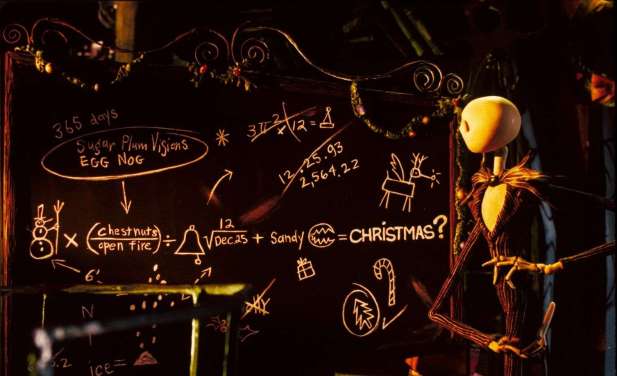
The story is a simple one. Burton was always a fan of those classic Christmas cartoons, but because he was also an obvious fan of the macabre, he asked himself, “What if there was a Halloween version of the Christmas villages and Whoville and what-not?” And so began the story of Jack Skellington, the man about Halloweentown, and the Bone Daddy who plans the Halloween celebration there every year. The only problem is Jack is getting a little bored with the same old Halloween stuff year after year. By sheer luck he stumbles one night into Christmastown, and discovers that there is a holiday where people don’t try to scare each other, but exchange gifts, instead. Jack is swept up in the idea of Christmas, but doesn’t quite grasp the spirit. He tells his fellow townsfolk about his findings, but they don’t grasp it, either.xmas

While agonizing over the spirit of Christmas, Jack builds a sleigh, reanimates some reindeer and decides to have Santa Claus (but since he’s the King of Halloween, he think it’s pronounced “Sandy Claws.) kidnapped, telling him that he can take the night off and Jack will bring presents to all the girls and boys. The real issue (besides kidnapping Santa), is that  Jack had asked everyone in Halloweentown to make the Christmas presents that he wants to give out and, well, they just don’t have the knack:

How-Terrifying.gif

The other issue is that Santa has been taken by the arch-villain of the movie (re-kidnapped?), the evil Oogie-Boogie, who appears to be nothing more than a burlap sack of bugs. Sally, a bride of Frankenstein-esque doll with the hots for Jack attempts to rescue him, but is also taken hostage, so jack must rescue them both. He does, rather easily, as he really only had to pull a loose string on Oogie and he came apart, literally, at the seams. As Jack is worried that Santa can’t complete his run and he has now ruined Christmas, Santa shows him the true meaning of the holiday by telling him that it ain’t just about the presents. So whether he finishes or not, Christmas will come. Of course, he will do it, because he’s Santa and he’s awesome. Also, Jack realizes that Sally is pretty cool, and that he is actually the Halloween guy, and he should stick to what he knows, which is scaring people.tumblr_mubkfcxgfl1rrhs85o1_500

You can look past the simple plot when you think about how long it must have taken to complete this movie, as the stop-animation wizards would sometimes get mere seconds of the movie filmed in a day. For the uninitiated, a film camera shoots at 24 frames per second, meaning that they animators had to simulate that by physically moving a model of the characters in the tiniest ways and take a picture of them, twenty-four times just for one second of the movie. It’s a wonder that the movie isn’t ten seconds long. You really have to admire the work that went int it, even if you’re the type of person who would walk out of the theater during the first few minutes.

One of the reasons this movie holds up, however, isn’t even the movie-making magic that is taking place, but the themes, and the age-old question, “Is it a Halloween movie or is it a Christmas movie?” At least, it’s an age-old question in my apartment. It definitely has the creepy, crawly characters that you find in most Tim Burton movie. But it also shows Jack discovering the true meaning of Christmas, like a lot of Christmas movies. And it’s because of this duality, because it works as both, that the movie stands the test of time. So watch it whenever you want. Whether you’re young or old, high school junior of grumpy old man. To admire the craftsmanship or enjoy the music or the simple holiday story, there’s really no other movie like it.

santa-jack-nightmare-before-christmas-226942_718_441

With all the Suicide Squad talk  that was floating around about what was cut and why, I thought it might be a good time to turn back the clock to a time when Warner Brothers actually made good comic book movies.

Maybe “good” is too light a word. And I honestly think that “comic book movie” pigeonholes this movie into a genre that immediately screams “low expectations.” I’m going to say right here for the record that Christopher Nolan’s The Dark Knight is one of my favorite movies of all-time. Not comic book movie, or movie that involves homicidal clowns. Just in general. Take every movie that I have ever seen in my 40 years of living, and this is probably top three.download
But is it? Does it still hold up in the wake of all the other blunders put out by Warner Brothers since? Or does it just shine brighter because those were so bad? Let’s find out.

After the events of Batman Begins, Gotham City has seen the crime rate drop, as criminals cower in fear when they see that signal light up the night sky. They also have a new District Attorney, Harvey Dent, who has vowed to put the mob out of business. Between Dent, Batman and Lt. James Gordon, crooks are on the run.

However, Batman has also brought out a little crazy in Gotham. One man in particular was so inspired that he decides to start painting his face like a clown and leave a Joker playing card at the scene of all his crimes. But the real crazy part of his M.O.? He’s robbing from the mob! This “Joker” then has the guts to crash one of their big boss meetings and tell them that, for enough dough (whatever he hasn’t stolen already), he’ll kill Batman for them. After Dent and Batman put the squeeze on the mob’s money launderer, they agree and hire the clown. And the dance begins.

Because this Joker is a lot more devious than Jared Leto’s (at least, the few minutes we saw of Jared Leto’s), he publicly dares Batman to unmask and show the world who he is, or he’s going to murder someone each day until he does. He then proceeds to blow up a judge that was scheduled to preside over the mob guys’ trial, poison the police commish, and then he tries to whack Dent (all in one night!), only to be thwarted by Batman. That encounter, however, only serves to heighten Joker’s obsession.

Because he knows that Batman can’t give in and reveal his identity, Dent tells the world that he is the Caped Crusader, and is locked up for vigilantism. During his transport to prison, Joker and his men attack, but the real Batman comes to the rescue, and they catch and arrest the Joker. Of course, this isn’t Cesar Romero’s Joker here, so it is revealed that both Dent and his fiancee’, Rachel Dawes (who also happens to be the love of Bruce Wayne’s life), have been kidnapped by Joker’s men while he was sitting in a cell.

This leads to the amazing interrogation scene between Batman and Joker, where Batman tries to get him to reveal their location, and Joker tries to break Batman down into a murdering psychopath like him. Joker finally tells him where they are, but knowing that Bats really will want to save Rachel, he lies and switches the locations, because there won’t be enough time to save them both. Oh, did I mention they are strapped to gallons of gas, set to blow? Not even Jack Nicholson’s version would have been that conniving. Probably.

Batman arrives at the spot that he thought Rachel would be held at, only to find Dent. He pulls him to relative safety and Dent survives the explosion, only half of his face was coated with gasoline and is severely scarred. Rachel Dawes wasn’t that lucky, and she is blown to bits in spectacular fashion, to the horror of Bruce Wayne, but the delight of movie audiences everywhere. (In case anyone forgot, Katie Holmes played Rachel Dawes in Batman Begins, but was so reviled that she was replaced by Maggie Gyllenhall in this one. Too late, it seems, because even though the actress was an improvement, people seemed to really hate Rachel Dawes no matter who was playing her.)

While Batman and the Gotham Police are rescuing people (badly), Joker easily escapes, not only blowing up the entire Major Crimes Unit, but also absconding with the mob’s money man, who gives him the all their cash. Joker then burns him alive, on top of the giant pile of mob money, because as the Joker himself puts it, “It’s not about money. It’s about sending a message.”

35fcfd0ee8e18dd27992518af758decc7dee842b4d7070ba8ed7b44596e87ed4

Joker then tells the people of Gotham that he’s going to blow up a hospital, but again that is just a smokescreen to kidnap a bunch of people, and have a little conversation with Harvey Dent about chaos theory. Harvey, who is already pretty broken anyway, realizes that Joker’s advice to “introduce a little anarchy” is dead-on, and begins his own life of crime, using a flip of the coin to decide if his potential victim lives or dies.

Meanwhile, Joker stages his final battle with Batman, using the kidnapped hospital folks, and two boats as his staging ground. One boat is filled with the worst kind of prisoners, while the other holds regular citizens, and Joker gives each boat a detonator, asking them to choose which one should be blown up. Because there has to be some happiness in this movie, the prisoners surprisingly refuse to blow up the regular citizens, and the regular citizens also decide to spare the prisoners. It illustrates the philosophical difference between Batman and The Joker as far as the film goes, but let’s face it, if this were real life, I’m betting both of those boats would have been blown to smithereens in seconds.

Joker has also dressed all the kidnapped doctors up as his clown-faced minions, and dressed his minions up as the kidnapped hospital workers, hoping that the police will fire on the wrong people. A good plan until Batman sticks his nose in, rescuing everybody. In the end, Batman does best the Joker in single combat, but that is to be expected. Joker doesn’t even seem to mind, really, because he has already won the war by corrupting  Gotham’s “White Knight,” Harvey Dent. Batman ends up confronting Dent and Dent is killed. Since no one but he and Gordon knew that Harvey had gone bad, and a murdering D.A. would have meant all those mobsters would have been set free, Batman nobly takes the heat for Dent’s death and is declared public enemy number one.

Wow, a lot happens in this movie. I probably could have glossed over some of those details and just said “Batman and Joker fight and Batman wins in the end. Yay!” But would that really have covered all the bases? There’s a lot of underlying stuff here, between Batman’s moral ambiguity and Joker’s revelation that Batman and criminals he fights aren’t all that different. During the interrogation scene, Joker rightly points out that Bats let five people die before Dent came forward and took his place, which he also allowed to happen. That’s the hero that Gotham deserves?

There’s also the whole Harvey Dent-Rachel Dawes-Bruce Wayne love triangle, which interestingly sees her choose the guy that isn’t Batman (just before her demise, but she did choose him), who also isn’t a complete scumbag. That is usually the case in Hollywood blockbusters, right? The new boyfriend of the hero’s ex is always a total jerk. Oddly enough, until the end, when he goes on a bit of a killing spree, Harvey Dent isn’t bad at all. He’s kind of the only guy in the movie that doesn’t have a bad streak in him. Even Jim Gordon is working with cops that he knows are corrupt, since that’s pretty much all there is in this city.

But what I really would like to get into is Heath Ledger’s Oscar-winning Joker, what some call the role that killed him. Please don’t think that I am making light of that terrible tragedy. But some do speculate that his dedication to the role at least partly contributed to him losing sleep, which lead to him upping his medication dose, and so on. But what was it about this Joker that lead him to that gruesome fate, while Cesar Romero, Jack Nicholson, Jared Leto, and even Mark Hamill, are able to laugh through it and move on?

Because this guy was crazy!
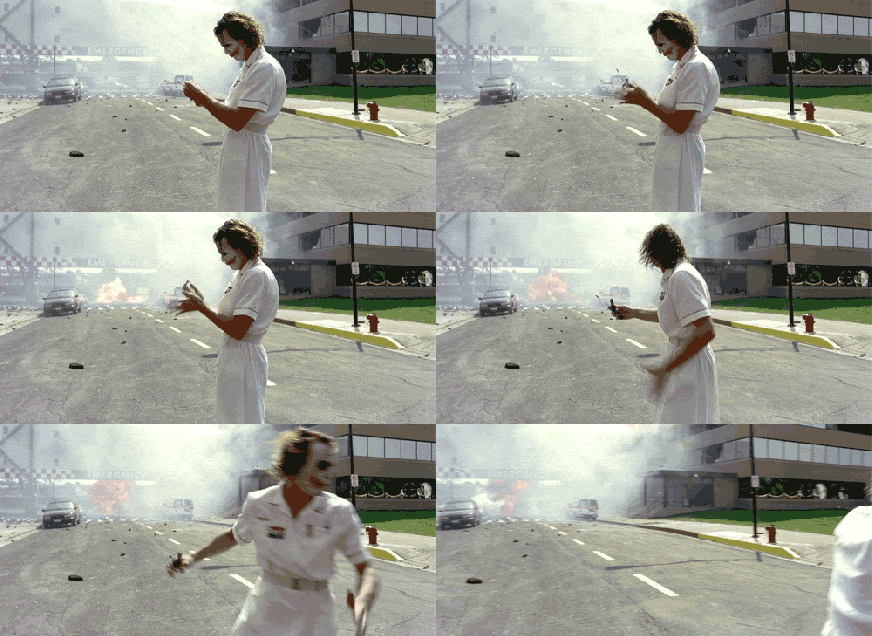
joker-nurse

Obviously, Jack was comic book villain crazy, and I’m not saying that he didn’t bring his own Nicholson-ness to the role, and blaze a trail for all future Jokers. And maybe Romero had his impact as well, although probably more in a “Don’t be like him” way. And Mark Hamill is an awesome Joker on the animated series, but it is animated, and I don’t think he’s really allowed to go full homicidal with that character. But Ledger? His Joker was nuts!

Or maybe not. Maybe he was brilliant. Despite what he tells Dent in the hospital scene about not having plans, claiming that he’s like s dog who chases cars, Joker does seem to have a few good ideas. He steals money from the mob, which only serves to wake the cops up to them so they can throw them in jail. He then takes out a couple mobsters for good measure. He also tries to get his “frenemy” Batman into the game by asking him to reveal who he is. And then he converts Dent into the fold. As he says,”introduce a little anarchy… and everything becomes chaos.” And the best part? Chaos is fair. Did I mention that he’s wearing a nurse uniform while he’s saying all this? Maybe he is a bit off.

In the end, most of the mobsters are either dead or in jail, and the corrupt cops are all pretty much out of the picture, too. Harvey Dent is gone, and Batman goes into hiding for the next 8 years. As this redditor puts it, Joker is actually the protagonist of the movie. I don’t know about that, but he definitely restores balance to The Force, so to speak.

It’s been eights years since this movie came out, and we’ve seen a lot in that time. Even a new Joker and Batman. This new Joker acts a lot like the previous one, just with a few more tattoos, but he doesn’t really have any cool ideas, or theories on chaos, or anything to do with anything except he laughs and wears purple. And the new Batman? He’s just kinda old. But when I watched The Dark Knight again recently, I realized that we didn’t need those new ones, because these 2008 versions hold up just fine. In fact, I started thinking about the current state of the world. I thought about the corporate bigwigs that The Joker would probably call “schemers.” I thought about the current political climate, and the upcoming election, and how maybe someone needs to introduce a little anarchy into that (although, I wouldn’t call Trump a “schemer,” since he doesn’t seem to have any plans at all.) I’m certainly not abdicating violence, but maybe a little chaos wouldn’t be so bad right now. The Joker was right about one thing: chaos is fair, because, good or bad, we all get treated the same.

200w

Recently, my brother told me that he and my nephew had watched the first John McClane action shoot-’em-up Die Hard together. I was shocked for a moment, until I realized that my nephew is actually 16 years old now, and I probably first saw Die Hard when I was twelve. And look how I turned out!

Anyway, my brother and I then discussed the movie for the first time in awhile. I honestly feel that he has embraced this fatherhood thing on a new level now that his kids are old enough to watch movies that he loved when he was younger, and now he gets to look at them through fresh eyes. As we discussed the movie, I sort of did this vicariously, as well.

I won’t get into the whole plot of the film, but in case you’ve forgotten, it should suffice to say that some call it the greatest Christmas movie of all time, while my Dad once referred to it as “The Guy in the Tower with the Bloody Feet.” Yes, the bloody feet is the lasting image for most viewers, but as my brother and I dissected it, I realized there’s a lot more to this one than one cop killing a bunch of bad guys.

The thing that separates Die Hard from all the knock-offs that came after it (including thegiphy actual Die Hard sequels that followed) was the personal touches to the characters, especially the bad guys. Hans Gruber, of course, played by the amazing Alan Rickman, in his big-screen debut, if you can believe it, unfortunately inspired a generation of less-amazing actors playing less-amazing villains, but Hans was superior because he actually felt like a real person, not your token raving lunatic. You get the feeling that Hans didn’t even really want to kill people. They were just standing in the way of his $640 million. Hans also is sympathetic to the pregnant woman that he has taken hostage, and agrees with Mrs. McClane that the hostages have to use the bathroom. No Bond villain has ever been that nice.
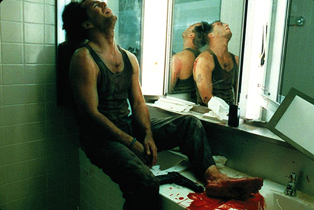
Hans’ right hand man, Karl, played by the late Alexander Gudunov (Boy, these Die Hard terrorists are dropping like flies!), also had real motivation after his brother became John McClane’s first kill of the movie. And it can almost be said that McClane didn’t really *mean* to kill him. I mean, it happened, and McClane certainly didn’t feel bad, but they were struggling and fell down the stairs and the guy broke his neck. Sorry, Karl. Can’t make an omelet…

There’s countless other little touches that make the terrorists into real people, from the one who steals the candy bars as he’s waiting to shoot the SWAT team, (Side Note: I just remembered another interesting moment from that scene: when Hans tells his men to “Just wound them.” He says it in that cold, Alan Rickman-way, but you get the sense that he kind of realizes these poor schmoes are sitting ducks, so let’s not actually kill them. They’re just working-class slobs, after all.), to the computer guy who actually scratches his nose after he kicks a guard’s dead body over. I mean, it has nothing to do with the plot, but terrorists are people, too, and people scratch their noses. I don’t recall any nostril penetration, but who knows? And if you want to get all psychiatrist on me, you could make the argument that it’s more twisted to scratch your nose after you help kill a guy, or that it’s more painful for Hans to “just wound” the SWAT team rather than just blow them away, but the point is, no other movie villains bother with these subtleties.

Even with all these small personal touches for the bad guys, no one in the movie represents the regular Joe more than the hero, John McClane. McClane is a cop from New York who is visiting his estranged wife in L.A., and just happened to be at the Christmas party when Hans and his boys showed up. As the only person who managed to get away, and because he still has a thing for his wife, it falls on him to stop them. Or at least not get killed. He obviously has no plan at all, which is what makes him such a great hero, and this such a great movie. Unlike Rambo or Chuck Norris or whoever, John has no real fighting skills, no special training that makes him better than his rivals, other than “cop.” He’s not really even in great shape. I mean, he looks great for an average Joe, but he’s not Schwarzeneggar or anything. All he has is a gun and his wits, and an attitude that allows him to push the envelope. Even as he encounters his first terrorist, Karl’s brother, and the terrorist says that he won’t shoot him because policemen have rules, John quips, “Yeah, that’s what my Captain keeps telling me.” So, we get the sense that even though he’s a regular guy, he’s not a regular cop. Or even a very good one.

Still, there are elements of him that are not like his action-hero contemporaries. When he is on the top of the building, which he knows is set to explode, the only way he even has a chance of surviving is to jump. So, as he ties a firehose around his waist, the only pep talk he can think to give himself is, “John, what the fuck are you doing?” He then tells God that if he lets him live, he will never think of going up in a tall building again. I don’t recall Arnold ever uttering a prayer like that. In fact, Arnold probably would jump without the firehose.

explosion

Arnold also never had to deal with bloody feet. The story with that is that McClane’s neighbor on the flight to L.A. was a seasoned traveler who told him that the secret to surviving air travel is to take off your shoes and socks and make “fists with your toes.” It just happens that the terrorists attack just as John is practicing his toe-fisting, thus he spends the entire movie running around a building fighting terrorists barefoot. Now, come on, what action hero outside of Bruce Lee spends the whole movie fighting without shoes? Not only does John McClane do it, but he pulls it off without looking silly. It becomes a  bit of an issue when Hans orders his cronies to shoot out a bunch of office windows, but otherwise,… masterful.

I remember taking a screenwriting class years ago that covered Chinatown, and how the studio was opposed to having the hero of the movie spend half of it with a bandage on his nose, but that’s what people remember about the character. It doesn’t take away from the character at all, but rather adds to it. The no-shoes aspect adds to John McClane’s struggle and makes you feel for him more, especially after the whole glass thing. I don’t even think any of the more established (at the time) action heroes could have pulled it off without looking a tad ridiculous. Bear in mind, Bruce Willidiehard_2_glass_600s was basically known as a comedic actor (the funny guy from Moonlighting) at this point. In fact, even with all my talk about how great a job Willis does at playing the “everyman,” the role was supposedly offered to many in the action hero community, like Sylvester Stallone, Harrison Ford, Robert De Niro, Charles Bronson, Nick Nolte, Mel Gibson, Richard Gere, Don Johnson, Burt Reynolds, and Richard Dean Anderson, and thank frikkin’ God they all turned it down. Can you imagine McGyver running around a tower with bloody feet? The movie would have bombed bigger than Nakatomi Plaza!

The climax sees McClane at his odds-beating best (three terrorists, two bullets, what’s a guy to do?) McClane is able to K.O. one with the butt of his gun, leaving just two. However, Hans has discovered that he has his tormentor’s wife in the throng, and is holding her at gunpoint. McClane, recalling their earlier exchange about American westerns, tapes his gun to his back and, for all intents and purposes, surrenders, lacing his hands behind his head like a classic action hero, stating, “Ya got me.” He and Hans share a laugh as the German butchers the famous “Yippee-ki-yay, mother fucker,” line, and when Hans has dropped his guard, McClane pulls out the gun and blows the final two terrorists away with his last two bullets. Hans does manage to hang on to McClane’s wife for a brief moment as he falls out the window, but John is able to rescue her, by unsnapping her Rolex (mentioned earlier in the movie as a gift for all her hard work. Nothing is by accident…). Hans’ slo-mo demise is one of the few action movie cliche’s in the whole film, but it was the late-80’s so we’ll let it slide.

giphy-1

Like I said in the beginning, Die Hard more than holds up, and is separated from the pack of bad action movies that came, and is still coming, after, because it is written to be believable. Most Rambo movies are basically the same as this, where it’s one guy versus a billion and he just shoots them all. But this one is structured so well that you can believe that this one guy took out all these bad dudes, and did it with gumption and wits. It’s another thing I learned in screenwriting classes; if you’re going to write a movie that involves a time-traveling car, you have to write it so that the audience believes it can happen. If you’re going to write a movie where one cop with no shoes is going to take out twelve money-grubbing terrorists, you have to write it to make us believe it can happen. Not that we know it will, but that we believe it will.

While you’re at it, believe in Santa Claus! Happy Holidays, everyone!

When reading through these posts, you may get the idea that most movies don’t settle very well. Mainly, that as I get older, I tend to think about movies differently and my perspective changes and now movies I used to like all stink. Or that maybe I just don’t like any movies. I have actually been accused of changing people’s minds on movies before, which is certainly not my intention (well, perhaps subconsciously), but I spent four years in film school, so I apologize if that changed how I watch movies. Also, someone has spent trillions of dollars on these movies. The least I can do is give it some thought. Lord knows, sometimes no one else has (directors included.)

So, I’ve been wracking my brain a little for a suitable movie that has settled well, but not necessarily because I’m older and grumpier now.The one I came up with has settled well simply because it was so prophetic, which is saying something considering it was a semi-brainless Arnold Schwarzeneggar action movie. I give you… The Running Man.

Set indownload 2017 (thirty years in the future when the movie came out in 1987, but a few months away now), the movie takes place in a world where the most popular show on TV is  a reality game show that is part-American Ninja Warrior, part-WWE Raw, and part-Family Feud, with Richard Dawson even playing the host. He even gets to kiss an old lady from the audience.
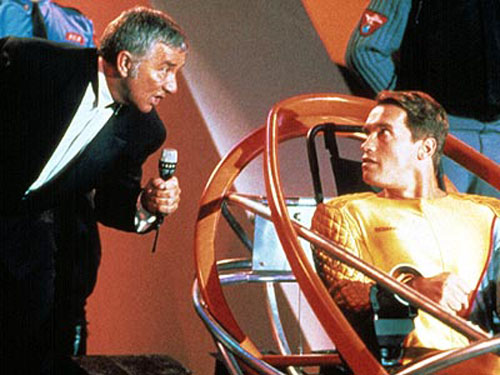

Sure, in 1987, it seemed pretty far-fetched.  When the book it was based on was originally published by Stephen King (as Richard Bachman) in 1982, it was even more out there (TV shows that debuted in 1982: Family Ties, Cagney & Lacey, Square Pegs and Knight Rider. Not exactly what King had in mind.)  In this 2017 – 2025 in the book – television networks pretty much rule the country and “The Running Man” is it’s undisputed ratings king. The show offers convicted felons a chance at a full pardon (and apparently a trip to Maui) if they can survive a run through the Game Zone while being chased by “The Stalkers.”  Sounds preposterous, right?  It certainly did even to my ten year-old ears, until several years later when I saw Survivor for the first time.  Obviously, there are no Stalkers, and inaugural winner Richard Hatch was actually convicted of tax evasion after his big win, but the similarities are still there.  Although Survivor host Jeff Probst can’t hold a candle to Dawson’s Damon Killian, who encouraged one of his minions to tell the State Department to “go f*** themselves.” It was one of the most hilarious moments of my youth. And I really didn’t even know what the State Department was.

According to the movie, there has been a worldwide economic collapse, forcing the U.S. into a totalitarian police state (must have been the Trump Presidency). Consequently, all the fun stuff, like art and music, has been censored unless mandated by the government. With no other entertainment to turn to, the public is pacified by government-sanctioned television. It all sounds very diabolical, but, really, are we that far away from this?

This particular episode of The Running Man follows Arnold Schwarzeneggar’s Ben Richards quest to finish the game.  Richards was a military helicopter pilot wrongly accused of massacring a crowd of people during a food riot.  Obviously, Richards is the one good cop in the bad town, screaming, as only Arnold can, “All dey want is food, for God’s sake!” Unfortunately, Richards is subdued when he disobeys the order to open fire on the rioters, and then his evil colleagues carry out the massacre, anyway. With the help of some snazzy, 1980’s video editing, they are able to pin it on Gentle Ben, and he goes to prison. Months later, Richards, because he’s Arnold, leads a jailbreak, and his asked by his fellow convicts to join The Resistance, a rag-tag group of dissenters who oppose censorship and oppression and good TV. The Resistance is oddly led by Mick Fleetwood and Dweezil Zappa, so no wonder they were trying to snag a guy like Arny.

Richards turns down their offer, and seeks out his brother, but finds Maria Conchita Alonzo living in his brother’s old place. He promptly kidnaps her and tries to make his getaway to Hawaii, but she turns him in and he is arrested again. When Killian finds out that it may be possible to get “The Butcher of Bakersfield” on his show, he makes a few call (hilariously to “the President’s agent”), and Richards and two of his weenie Resistance buddies are the newest runners.runningman1

As the game progresses, though, something different happens when Arnold starts killing The Stalkers. Instead of the trip to Maui, though, which we learn isn’t a thing because the winners were all rigged and those chumps died just like everyone else, he and Alonzo (who got tossed in for trying to help him) look for a secret and rather convenient Resistance base in the Game Zone. They find it and present evidence that Arny was framed and broadcast it all over the world during the show, since everyone is watching The Running Man, anyway. Even though that should have been enough to bring the whole network down, it’s not enough for our hero, who has to go in guns blazing to take out Killian, who, despite being the main villain in the movie, is actually just a game show host. Imagine a former Price is Right contestant getting so disgruntled that he felt he had to go back and murder Bob Barker?

As I said earlier, the reason this by-the-numbers, 80’s action flick settles well is because it was kind of ahead of its time, even down to the pre-Draft Kings gambling that went on in the streets as the show was happening. One of the turning points for Killian was when he realized that people started betting on Richards to win the game, which was apparently never done. People love the underdog, even when it’s Arnold Schwarzeneggar. It is pretty interesting, though, when you watch wrestling, UFC and even football games these days, the resemblance to what was depicted in the movie is uncanny. For years, I actually thought that UFC was rigged, much like The Running Man, because it seemed like the fighters who won just happened to be the most popular. Ronda Rousy’s huge loss proved that I was wrong, but the very fact that I was suspicious probably says all that we need to say about that.

It’s not just the physical competition TV shows that remind me of the movie, though, because there are about a million so-called reality shows that also fit the bill. Chefs, tattoo artists, car builders, gold-diggers, hicks making moonshine, or whatever. They all have a little Running Man in them. Other than Dawson, the best performance in the whole movie might be by future-governor Jesse Ventura, basically playing himself as a former Stalker who believes, like a lot of former athletes, that the game shouldn’t be messed with in the name of ratings. When Ventura refuses to come out of retirement to face Arnold on the show, the network folks simply digitize the real faces over stunt-doubles and stage the fight, anyway. That’s a trick that happens in every action movie these days, but this was 1987, remember.

therunningman

So, if all that other stuff has happened, how far away are we really from watching people kill each other for money on a regular basis? Honestly, if The Running Man was on today, would you check it out? Or at the very least, bet on it in Draft Kings?


As with my last current edition (Batman v. Superman: Dawn of Crap), I am tackling a movie that seems to be polarizing the movie-going public with the new rendition of Ghostbusters. But before I begin, I want to just lay it out here that, although I loved the original, and I never really saw the need for the new one, I went in with a completely open mind. Even better, I actually went in kind of looking forward to it. My first big mistake.

I also want to say before we get rolling that I am not one of those dickhead trolls who doesn’t think that the movie shouldn’t be made because it cast the four leads as female. As remakes go, at least this was an attempt at breaking new ground, and the four females in question are usually pretty funny performers. I actually never understood that whole backlash in the first place. I personally love women, so why not put them front-and-center more often? So, don’t get on me for being anti-feminist or something when I start ripping this thing apart.

First, let’s jump into the Way-Back Machine and punch in March 3rd, 2016, when I first saw a trailer for this new re-imagining of the 80’s classic. Upon seeing the first trailer, I can say unequivocably that I hated it. I can’t really pinpoint what it was about the trailer, but it just screamed “unfunny” to me. I was instantly worried, because I thought my future girlfriend, Kristen Wiig, was capable of more. The subsequent trailers and Papa John’s sponsorship did nothing to quell my fears, and I decided that I would probably skip this one.

Then it came out, and reviews started popping up, and they were good! Rotten Tomatoes had it rated Certified Fresh on opening day. Maybe the trailers were just edited poorly. Maybe it has funny lines not shown in there. Maybe it is just a fun, summertime romp.

ghostbusters-2016-cast-proton-packs-images

This is a good lesson for the children out there to always trust your instincts. Or, perhaps, more appropriately, I think this old chestnut applies here: “If something looks and smells like shit, that means it’s shit.” I only laughed a couple times during the entire movie, and one of them was when Chris Hemsworth, the Ghostbusters’ dumber-than-dumb secretary relayed a message that there  was”a goat” roaming around in a theater. See, he meant “ghost,” but because he’s so stupid… heh-heh. Never mind.

But I don’t want anyone reading this to think that I disliked this movie because “reasons,” because I have actual reasons. Reason #1 is that I was kind of offended. Not as a man or a fan of the original, but as someone who purports to write screenplays once in awhile. They had a premise ready-made. That’s a good chunk of the hard work done right there: “Let’s put 4 people in these jumpsuits and have them hunt ghosts.” They don’t have to pitch anything. All they have to do is write some witty dialogue, and these four talented women should be able to handle the rest. They almost couldn’t lose, and yet…

My second biggest problem is actually the most glaring one, and this is why I was surprised that so many people actually claimed to have liked it. A lot was made about how this movie was breaking ground by casting four women leads in a big-budget, tent-pole summer movie, as if no woman had ever been in a movie ever.And I was all for that. Unfortunately, instead of breaking new ground, this movie decided to just trudge over the same old ground that has been trudged on by every other big-budget, tent-pole summer movie. Let’s see, the black woman has to play the uneducated Ghostbuster, who yells really loudly all the time, and who lends her knowledge of the New York subway system to the team, while the three white Ghostbusters are all scientists. Was that supposed to be an homage to the original, or are they just that uninspired?

Along those same lines, Melissa McCarthy basically played the exact same role that she plays every time she is on-screen, which is loud, over-weight funny lady. Don’t get me wrong, she does it well, but wouldn’t it have been a refreshing change if she played the shy, quiet one for once in her life? And lest you think I’m being biased, Wiig pretty much played the same mousey girl that she plays in all her movies, too, which was also quite irksome.

This wouldn’t have bothered me so much (Hey, men, women and children play to type in Hollywood movies all the time, and they basically print money, so…), but so much was made about this wonderful new Ghostbusters team that’s all female, maybe someone could have done these women the favor of writing them a decent script. In all the meetings that take place before anyone actually films Act I, Scene A of any movie, did nobody stop and go, “Hey, I know it’s a remake, but isn’t this a little too unoriginal?” I mean, they were under pretty heavy scrutiny as it was. Wouldn’t this be time to try something a little different? Would it have killed them to shake things up a little bit?

I also wondered about the anti-feminist approach to Chris Hemsworth, who is playing eye-hqdefaultcandy for sure, which I suppose could be looked at as a nice, little switcheroo, because the secretaries are always played by hot chicks. I just didn’t understand why Wiig had to get all googly-eyed every time he walked in? She basically played the role of Jennifer Anniston in every movie she was in in the 90’s, basically setting women in movies back about 20 years. And the worst part, they never paid off that storyline! I mean, at least Bill Murray got with Sigourney Weaver at the end of the original, just to send everyone home happy.

But let’s face facts; making the black woman a scientist or Kristen Wiig getting with Chris Hemworth wouldn’t have really made much difference, because I’m pretty sure everyone was just cashing a paycheck on this one. One of my all-time favorite Saturday Night Live sketches took place in 1992, and it involved the late, amazing Phil Hartman as Bill Clinton, about to go into a Democratic Presidential debate with Jerry Browne, played by Dana Carvey. The two candidates are making agreements on which illicit things in their past that they will not bring up in the debate, and Clinton lists the movie Ishtar as one of his dalliances. for those who don’t remember, Ishtar was the 1987 stinker starring Warren Beatty and Dustin Hoffman as lounge singers who are somehow caught up in an international incident with the Emir of Ishtar. I’ve actually never seen it, but it’s universally recognized as being terrible. So, in taking the blame for the movie, Clinton says, “I said ‘Put Beatty and Hoffman out there in the desert, put a serape on ’em, and something funny will happen.'” I feel like that’s basically what was going on here. I feel like director Paul Feig said, “I’ll put these 4 funny women in a Ghostbusters movie and something funny will happen.” But you still have to, y’know, make a movie. The movie itself also looks like it was cut in a meat grinder, as they go from scene to scene with literally no flow whatsoever. One minute, they are meeting with the mayor, who is telling them to stop hunting ghosts, and in the next scene they are in an alley testing out their new ghost-fighting weapons, with seemingly no regard for what just happened. Anyone who has ever seen a movie before could probably predict that  all of these weapons would be used by the end, but it they were pretty much all used in rapid succession during the big climax, so we could have done without the exposition scene where you demonstrated what these things actually do to ghosts. We get it. You have fancy weapons. Don’t cross the streams (which actually never came up.)

In spite of all of these pitfalls, the movie scored a $46 million opening weekend, which is solid, and I’m happy, because I’m all for female leads in big movies. But beyond the box office, there are definitely people, critics and regular-folk alike, who enjoyed it. But I always kind of wonder what the agenda is here. One person responded to my Facebook post by saying that he went in with “the lowest of standards” and loved it. He went on to say that it “held its own,” and that is all you can ask for “in a sequel/reboot.” Now, I know that is one man’s opinion, but am I the only one who sees a problem with that? First of all, why did you see it if you had the “lowest of expectations?” Lowest seems pretty low to me. And since basically every movie is a sequel/reboot or comic franchise these days, what do you reserve the high expectations for? Like I’ve said before, I envy people like this man, who can walk into a movie with low expectations and be happy when it even slightly beats them. But I can’t do that, and to be honest, I don’t think anyone should. If we all had higher standards for movies, reboots, sequels, or whatever, maybe there wouldn’t be five Transfomers movies out there. And three Ghostbusters.

That is why I am so troubled by movies. I won’t say that I have high expectations for every movie I see, but I do actually want them to be good, and find myself constantly disappointed. If I’m spending my money, I want the movie to meet some level of quality, or else why would I waste my time? But through all the slime and the goofy cameos and the jazzy special effects, Ghostbusters could not come close to meeting even my middling standards. I guess it’s true what they say: “you only hurt the ones you love.”

erin-gilbert-kristen-wiig-slime-slimed-ghostbusters-2016-animated-gif

It’s always interesting to me how people can relate to certain movies and characters based on where they are in their lives while seeing the movie for the first time. For instance, Magic Mike always harkens me back to my days as a male stripper. This is probably why some movies don’t settle well, because they are meant to appeal to a certain audience at a certain time, but when that audience moves out of that time, the movie just doesn’t hold up.

But some movies do stand the test of time, because they appeal to a wider audience. I’ve written before about how 40-year-old Matt Dursin relates to different characters, even in the same movie, than did 25-year-old Matt Dursin. I’m starting to sound like a big Scotch-drinker, but it’s true. (2017 note: I, in fact, am a big Scotch-drinker)

However, I have a little trouble placing Good Will Hunting. On the one hand, it’s a really ridiculous premise: a genius kid from Southie works as a janitor at M.I.T. and solves equations at night when no one is around. OK, I can swallow that enough. Unfortunately, genius kid meets a girl, and decides to throw away the prosperous future that is being laid out for him, and leave all his buddies in Boston, and drive his beater across the country to chase her, after knowing her for just a few weeks. Also, he lied his face off to her and treated her rather poorly, so why she would even have him once he got there is beyond me. That’s where 40-year-old Matt Dursin has a problem with it.

But, it was 22-year-old Matt Dursin who saw the movie for the first time, and he saw it while living in L.A. Yes, the most Boston movie ever made up to that point, and I was 3,000 miles away when I first saw it, so sue me for being nostalgic. I was spending my final semester out there, and it was very much up-in-the-air on whether or not I would even return to the East coast after graduation. I’m not going to go so far as to say that Good Will Hunting had any impact on my decision, but I will say that, like Good Will, I came back because I had to “go see about a girl.” The thing is that girl and I broke up four months later, which is probably what happened to Will and Minnie Driver, and probably what would happen to most people in this situation. Let’s face it, at 22, you’ve still got a whole lot of livin’ to do.

Before I get into the nuts and bolts about it settling, here’s the skinny on Good Will Hunting: Like I recounted above, Will is a super-intelligent janitor at M.I.T who finishes equations at night for fun. He catches the attention of Field’s Medal-Winner Professor Gerald Lambeau (otherwise known as Creepy Stellan Skarsgaard), who sees world-changing potential in him. The tiny hiccup in Lambeau’s plan is that Will is a bit of a loser. giphyHe hangs out with a bunch of other losers, including Chuckie, played by pre-sexual harassment Ben & Casey Affleck. During one of their pointless skirmishes with other Southie ne’er-do-wells, Will punches a cop in the face, and so is in some hot water with the fuzz. Lambeau gets the judge to go easy on him and turn him over to the professor, and in return, Will must go to counseling. I didn’t think college mathematics professors had that kind of sway in our judicial system, but there you go.
Enter: Robin Williams. After Will out-smarts several eminent psychiatrists by insulting their masculinity, Lambeau turns to his former roommate, Sean Maguire (another Southie boy), played by Robin Williams in an Oscar-winning role. Sean is supposed to give Will direction, preferably the direction that Lambeau wants. Will sandbags Maguire at first, as he did with all the other shrinks, but eventually they bond over Game 6 of the 1975 World Series and the fact that their father-figures weren’t very nice to them. Man, Southie sure was different then.

They also talk a lot about Will’s new lady-friend, Skylar, played by Minnie Driver. Skylar is a Harvard med student who is soon graduating and moving to San Fran to continue her education, so Will sees little point in pursuing anything serious. Widower Robin Williams tries to convince him that he should give love a chance, but really, I think I gotta side with Will on this one. Eventually, good ol’ Chuckie finally rips Will a new one about how he has a winning lottery ticket for a brain, and he needs to use it and blow this burg. (2017 Note: It’s funny that, on the 20 year anniversary, people are talking about what a Boston movie this was, when the ultimate resolution is Will deciding that he needs to get the Hell out. Very Springsteen.)

Like I said, the end result is that Will takes off for San Francisco to follow Skylar, leaving Sean, Chuckie, Lambeau and everyone who helped him and was willing to help him behind. We don’t really know if he got an amazing job out there, but maybe he moved to Silicon Valley and became CEO of some awesome internet start-up. Or he kept mopping floors. Who knows?

I think we’re supposed to believe that he left it all behind for a girl, which I was all for when I saw it at 22. I vividly remember a conversation I had with one of my fellow students out in L.A. when I was discussing my “Will-I-or-Won’t-I” plight. he said, “What good is the greatest job in the world if you’ve got no one to share it with?” At the time I thought that was just wonderful, so I thought, “You go, Will!” I also didn’t know as much about Hollywood endings. Did I mention Good Will Hunting won Best Screenplay that year?

Here’s the real clinker, though; Older and wiser (and grumpier) me thinks about this movie now and marvels at the scenes between Sean and Lambeau. Despite the fact that they paint Lambeau as a total jerk most of the time, he makes some good points. He has seen firsthand Will embarrass brilliant mathematicians, and knows what Will can offer the world. In comparing Will to Albert Einstein, he says, “Imagine if Einstein had given all that up to get drunk with his buddies?”  If you want to say that Lambeau is the villain in this movie, then there is the motivation that makes him an interesting and believable character. Certainly much more interesting than Skylar.

However, Sean Maguire, the Obi-Wan Kenobi to Will’s Luke, makes a similar comparison to another brilliant mathematician: The Una-Bomber. Sean’s point is that if they rush things and don’t let Will grow on his own and face his past, then he could become a looney who blows people up. It seems a little overly dramatic, but it could have been a cool plotline if they didn’t spend so much time on the dopey love story.

The other cool part about the scenes between Sean and Lambeau is the history they have. At one time, they were contemporaries, but Sean ended up counseling veterans and teaching at Bunker Hill Community College after, presumably, meeting his wife. The unattached Lambeau became a sort of rock star mathematician, if that’s even possible, winning what is described as the Nobel Prize for mathematics. So, they took different paths, and Lambeau thinks that Sean is trying to use Will to get back at him for being successful, and Sean thinks that Lambeau is using Will to belittle him for not being successful. In the climactic scene that probably was on the Oscar nomination tape, Sean tells Lambeau that he knows who he is, and is proud of what he does, and in my favorite line, puts him in his place when he says, “I knew you before your were Mathematical God, when you were pimple-faced and homesick and didn’t know what side of the bed to piss on.”

Naturally, 22-year-old Matt Dursin could not possibly understand that kind of dynamic, but 40-year-old one does all too well, as I’m sure a lot of people do, in their own way. However, like Sean, I am damn happy with the choices I have made. Living in L.A. and working in the office at a movie studio probably wouldn’t have worked out too well, but then, I didn’t exactly have it all laid out for me like Will did.  No regrets there. But I do sometimes wonder what became of my L.A. friend who fed me that brilliant “No one to share it with” line. Was he the Gerald Lambeau to my Sean Maguire? I will probably never know, because I actually don’t even remember his name.

Seeing that this was the Little Movie That Could, and pretty much launched the careers of Ben Affleck and Matt Damon, it is interesting to peel back the layers a little bit. However, in the end, it boils down to a cheesy love story. But there was another moment that probably helped Williams win that Oscar, and that’s not part of the overall love story, but it is a love story: the love between Bostonians and their beloved Red Sox.

As I mentioned earlier, Sean and Will bond over Game 6 of the 1975 World Series, a game etched in Boston sports lore, and sometimes called the greatest game of the greatest World Series ever played. That game climaxed when Carlton Fisk hit the game-winning home run off the foul pole in Fenway Park, wildly waving his hands as he left the batter’s box, willing the ball fair.

Fisk-75-HR

You can’t write that stuff.

It’s hard to imagine it now, but in Boston before 2004, that was all the Red Sox really had as far as post-season history. And for it to be woven into the screenplay of a movie was pretty cool. Williams was recounting the story of the night to Will, saying that he and his friends had slept on the street to get tickets, but when Will asked him if he rushed the field, as the fans did in 1975, Sean said that he didn’t go to the game, because he saw a girl in the bar before and decided he had to “go see about a girl,” his future wife as it turned out. Will is understandably incredulous, but Sean tells him that he doesn’t regret anything, not the years spent counseling veterans, teaching at a community college, caring for his ailing wife, and he certainly doesn’t regret missing a baseball game. And he probably doesn’t regret not winning a Fields Medal.

That’s the real love story at work here; loving who you are. That’s why this movie, despite its flaws, does settle well, when you stop and think. It’s really about not living with regret and being happy with who you have become. No 22-year-old can understand that, yet.

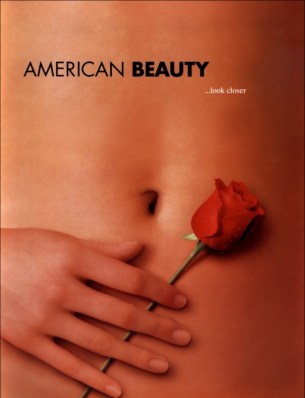
Sam Mendes’ American Beauty was considered one of the “20 Most Overrated Movies of All-Time” by Premiere magazine. Which is out of business. Maybe if they were still around, they could take the advice of the film’s tagline and “look closer.”

I’ve seen other instances of people saying that this film is overrated, or undeserving of the Best Picture trophy it received. And that may be true. I mean, I think a lot of movies don’t deserve their Best Pic wins. Since those awards are largely political and are rarely based on the actual quality of the movie itself, let’s just throw all that out the window right now and look a little closer.

american-beauty-aff-01-g

We need to look no further than the logline given on IMDB: “A sexually frustrated suburban father has a mid-life crisis after becoming infatuated with his daughter’s best friend.”

That is absolutely, 100% not what this movie is about. Sure, that is what happens, but whoever wrote that line for IMDB must not have actually watched the movie. To say that Kevin Spacey’s Lester Burnham has a simple “mid-life crisis” is not doing the character justice at all. Sure, he buys an expensive car and lusts after a high school hottie, but the character is so much more formed than that. It can almost be described as a spiritual awakening, rather than a mid-life crisis. (I don’t really like the idea of a mid-life crisis at 55, anyway. As Michael Caine once said, “Who lives to 110?”)

Lester is a regular, suburban guy with a teenage daughter, Jane, who hates him, and a battle-ax wife, Carolyn (played by Annette Bening) who also kind of hates him because he doesn’t help her portray the typical American family unit. He is crapped on at his advertising job by younger execs, and his life is basically defined by a scene where he is dragged by his wife to see their cheerleader daughter perform at her high school basketball team’s half-time show. Lester’s reaction? “I’m missing the James Bond Marathon on TNT.”

However, during the performance, Lester sees Angela (Mena Suvari) for the first time. In a beautifully-shot sequence, Lester fantasizes that she is performing just for him in what basically amount amounts to a striptease, except when she opens her sweater, rose petals float out:

tumblr_nvastbCqWQ1tcwfuio1_400

It’s pretty awesome.

Anywho, this sets Lester off quite a bit, as after over-hearing Angela tell Jane that she likes dudes who are fit, he begins working out. Lester is further awakened when he is re-introduced to pot by the neighbor’s son, Ricky, and then he really starts to turn it around. Hey, it is a gateway drug!

Ricky and his family are an interesting lot. His father is a retired army Colonel, who seems to hate everything other than his son, especially gay people. After a gay couple that lives in the neighborhood welcome him with a gift basket, the Colonel wonders out loud to his son why “them faggots always gotta throw it in your face?” He also keeps close tabs on Ricky, who has been busted for selling and using drugs in the past. As I said, he clearly does love Ricky, but you can tell that he is more than a little disappointed that his son isn’t anything like him. Incidentally, Ricky’s mother, played amazingly understated by Alison Janney, is just weird.

Lester asks Ricky if he can buy some more weed from him, and Lester sees Ricky’s room for the first time, and he sees all the high-end technology that selling drugs can buy. Lester tells Ricky that when he was his age, he flipped burgers all summer to afford a stereo. When Ricky replies that that sucks, Lester responds with one of the great lines of the movie: “Actually it was great. All I did was party and get laid.”

This inspires Lester to quit his job, as he saw Ricky do the night before. Lester also screws his company out of three month’s salary by threatening a sexual harassment suit, and applies for a job at the local fast food joint. When he is told that they aren’t hiring managers only counter workers, he rattles off another one of my all-time favorite lines: “Good. I’m looking for the least possible amount of responsibility.” And let me say here that I don’t know if anyone other than Kevin Spacey could have delivered that line with such aplomb.

Lester’s marriage is also falling apart, if it was ever together to begin with. But it isn’t just him who is unsatisfied, as his wife begins sleeping with a fellow real estate tycoon, who also encourages her to go to a shooting range to pop off a few rounds when she gets stressed out. This brilliantly shows that there are two sides to an unhappy marriage, and they don’t just make Annette Benning’s character out to be some horrible shrew. She actually has feelings, too. Lesser screenwriters take note: All your characters matter.

However, it is still mainly Lester’s story, so when he catches his wife and her lover canoodling at his drive-thru, it leads to another moment of realization for him when he tells her, slowly and with conviction: “You don’t get to tell me what to do… ever again.” I think it’s something a lot of people wish for, and Lester has discovered it: control. This is another huge step towards his spiritual awakening. He’s not even really mad at her for cheating. In fact, he seems pretty pleased with himself over it.

Just as Lester’s total transformation is about to net him the object of his desire, Angela, he learns another truth: all her talk throughout the movie about the myriad sex she’s had is just bluster. She actually is a virgin. Even though she says she still wants to, this gives him pause. As crazy as he seemingly has gotten, he still does not want to be That Guy. There seems to be some discrepancy over this fact on the movie’s IMDB page. I’m not sure why, but one poster said something about Angela saying that she was a virgin so that Lester would enjoy it more because guys like having sex with virgins. It’s pretty obvious to me, due to her crying after he decides to not have sex with her, that she was making it all up just to feel superior to Jane, and probably everyone else. I am not sure why someone would jump to the whole Guys Like Virgins thing rather than just assume that a teenager was lying about their sex life, but hey, you go with whatever.

Instead of nookie, the two share a moment when he asks her if she thinks that his daughter is happy. When she tells him, “Yes,” he realizes what is really important in life. It’s not the shiny, red car he bought, or the muscles he put on (or the weed, presumably). He looks at a family vacation picture from long ago and realizes just how lucky he really is.

And then he is shot in the head! See, not too long before his big moment, his crazy Colonel neighbor came on to him, thinking that Lester was actually a homosexual (Lester had told him that his marriage was just a facade, and Colonel Fitts got a little confused.) After Lester politely rejected him, the Colonel felt humiliated and decided to go home and get his gun. He then blew Lester’s head off to prevent his secret from getting out. Or for revenge. or because he was just crazy. It’s really another interesting layer to a character who was seemingly just a giant bigot, but in actuality an anguished closet homosexual.

The best part, though? Lester died smiling.

Processed with VSCOcam

I could write all day about the themes of this movie, about the red-on-white color scheme, the Lolita references, the meaning of the blowing plastic bag, etc. But what I really wanted to focus on was what was really going on with this guy. To me, Lester isn’t experiencing a mid-life crisis, and he isn’t lusting after Angela in some sort of Lolita-like way, and he wasn’t just some pothead. He’s simply feeling the Weight of Responsibility that a lot of people feel at some point in their lives. This was how he decided to deal with it.  Peter Gibbons from Office Space chose to deal with it a different way, but we all kind of have to deal with it somehow. There are different responsibilities, of course; financial, family, just generally fitting in to society. But we all have them, and if, like Lester, your job and your marriage suck, well then you quit them and move on. If you want to call that a mid-life crisis, then that’s your call. I prefer to agree with Lester himself. After his soon-to-be ex-boss calls him sick, he replies, “Nope. I’m just an ordinary guy with nothing to lose.”

In the end, he realized that he did have his family to lose, but at the time he said, it was total truth, and not the words of someone going through a mid-life crisis. this guy knew what he wanted, and got it.

Well, everyone is weighing in on this one, so I figured I would, too, but no matter what any critic, blogger, pundit or neophyte out there on the internets says, the only opinion that really matters has spoken, to the tune of the largest March opening weekend ever, and the sixth biggest U.S. opening ever. I don’t really understand it, but about $20 of that were mine, so I guess I’m just as crazy as the rest of the country.

batman-v-superman-dawn-of-justice

The opinions of this *ahem* film seem to range from “absolutely terrible” to “wasn’t that bad.” That’s certainly not a wide range, and I don’t think I’ve heard too many people say it was actually good, but that’s what’s kind of interesting to me. Despite the fact that people either think it’s one of the worst movies ever made, as I do, or they think it is just “not bad,” it seems to be a very polarizing piece of pop culture, especially in the comic book fandom. There is definitely a fair amount of comic-movie backlash floating around these days, but some of us who are devoted fans of the genre will defend it to the death, especially to those non-fans. It’s like Mel Brooks making fun of Jews; he can do it and it’s not offensive because he’s Jewish. You can’t make fun of my comic book movies because you’re not a fan and you don’t know my pain! I’ve waited my whole life for this!

Still, even though I am a comic book reader, that doesn’t mean I go all in. I mean, I also like baseball, but I don’t love every team. And when you really think about it, there hasn’t been a decent Superman movie since 1980. That’s five really bad movies in a row over 36 years. How many does it take before someone says, “You know what? I don’t think Supes works.” Apparently never, because we’re stuck with a few more of these Zack Snyder crap-fests over the next five years.

That aspect may be more remarkable than the public opinion of this movie; the fact that Warner Brothers felt so far behind Disney when it came to comic book movies that they jump-started their whole slate of tentpoles for the next five years with this one, never once thinking, “What if nobody likes it?” Next summer, we have Wonder Woman, followed by Justice League: Part One in November, then The Flash in Spring 2018 and the long-awaited Aquaman solo film for your summer popcorn flick in 2018. If that doesn’t make you want to toss your lunch, 2019 brings us Shazam!(?????) and Justice League: Part Two. Wow! And if I’m not in prison for murdering Zack Snyder by 2020, we’ll have a Cyborg solo venture, and a Green Lantern Corps movie. That’s eight movies, plus whatever Ben Affleck solo Batman films they churn out. And we are not off to a good start.

(PLEASE NOTE: I intentionally left out Suicide Squad, because I don’t really think they will have much interaction with the other DC heroes. Plus, that trailer doesn’t look that bad.)

Now, I know the counter-argument is Marvel’s Guardians of the Galaxy, which was a movie with characters nobody had ever heard of that was way better than anyone expected. And yes, it could happen. Shazam! could be a Tour de Force of cinematic wonder. I’m just not holding my breath. And I know it’s hard for some, because most of my friends don’t know which company puts out which movies, but let’s not even compare the DC films to the Marvel ones, because they are using completely different pizza recipes, as far as I’m concerned. It’s like comparing all other animation companies to Pixar.

The funny thing is none of this actually matters a whole lot because Batman vs. Superman is being judged in the court of public opinion, which, thanks  to social media and people (myself included) wanting to get their two cents in, is not a vacuum. Last week, when the first reviews were coming out, the majority of them were negative. Then when the general public started seeing it, we saw more backlash. Rotten Tomatoes at this moment has it at a pretty abysmal 29%. By way of comparison, the universally-panned Phantom Menace is still pretty low on the Tomatometer, and that is at 56%. Still, way better than BvS.

how-lois-lane-could-have-a-key-role-in-batman-v-superman-dawn-of-justice-too-funny-208417

But then came the apologists. The people who just need a couple hours of entertainment. The people who just wanted to see some explosions and some pretty people duke it out. The people who really, really wanted to like it, so they willed it into the Not Bad category. And that’s totally fine. I sometimes wish I could be one of those people. But I went to film school and have a pretty analytical mind, anyway, and so I am cursed with having to wonder what went wrong. I mean, hundreds of people are involved in making every blockbuster. I can’t believe someone involved didn’t have the kahones to walk up to Zack Snyder and say, “This is drivel.” Or maybe they did, and he took the Billy Mack route. I mean, it made $170 million on opening weekend. I’d call that sold gold shit, all right.

But what I really want to study is this cultural phenomenon of a lot of people really hating a movie, and then suddenly a bunch of people coming out and saying it’s “not that bad.” I don’t know if it’s an underdog thing, but I’ve heard people stick up for this movie like it was a person. We’re talking about a major studio blockbuster release here, which probably cost about as much as it takes to launch a space shuttle, not some indy director trying to make it in this cutthroat business. And what does “not that bad” even mean?  To me, “not that bad” is kind of just a euphemism for “not that good.”

To be fair, some people seemed to have kinda-sorta actually liked it. One common (semi-)positive review is that it’s better than its predecessor Man of Steel, which is kind of like saying that one carton of sour milk tastes slightly less sour than another. However, that same reviewer goes on to say that ” ‘Batman v Superman’ is neither as stupid nor as stupendous as it might have been.” So, it’s not as stupid as it might have been? Seems like this guy still thinks it’s kind of stupid. But somewhere between stupid and stupendous then? Gotcha. Sounds like another way to say “not that bad.”

Andrew O’Hehir from Salon.com wrote: So Batman v Superman is kind of dopey and plays out some laborious plot twists in the DC narrative at unnecessary length, but as I’ve already said it largely kept me entertained for two and a half hours, which is not nothing.” No, but is it something? He also says that “This movie isn’t nearly as terrible as I was expecting.” These seem like apologist reviews to me.

Even Comic Book Resources, which should be this film’s bread-and-butter, could not sugarcoat this movie. That’s right. Even a comic book fan called this movie “a trainwreck.” And it is. Jesse Eisenberg plays the worst criminal mastermind in film history. Superman isn’t the Man of Steel here, because he’s actually wooden. Wonder Woman is fine, for the entire seven minutes she’s onscreen. The Aquaman cameo is one of the dumbest things I’ve ever seen in any movie. And the long-anticipated battle of the century (y’know, Batman vs. Superman) takes so long to develop that they only have a few minutes to actually fight, since they didn’t really start until the thing was already around the two-hour mark. Plus, the trailer pretty much gave away that they would be buddies by the end, anyway.

But that’s just one side of the coin. Of course, every movie has its supporters and detractors, but this one seems different somehow. Some movies are needlessly long and drawn-out. Some movies are poorly acted or poorly written. Some movies are weighed down by too much plot and not enough action. Some movies just insult my intelligence. This movie does all of these things, and yet, some people liked it. Or at least, it wasn’t as terrible as they thought it would be. Why? I’m not sure. Maybe they like going against the grain. Maybe they don’t care so much. Maybe it appealed to them in some other way (and I don’t fault them for that. In fact, I’m sort of jealous.)

Or maybe they felt bad for poor, old Ben:

I could watch that all day.

It’s possible I may be picking on someone’s favorite movie with this one. Or maybe not. I really don’t have a very good gauge for contemporary pop culture. That’s why I write about movies from many years ago and whether they’re still good or not. It’s sort of my thing. Although I’m definitely not alone, because I did find this article during my research.

The other reason I write about these movies is because my opinion on them has usually changed greatly over time. This change may be due to circumstances in my own life, or the changes may be more societal, but something has brought it on. Obviously, since the movies haven’t changed much, unless it’s Star Wars and George Lucas has been dicking with it. But I am aware that some people’s opinions don’t waver like mine, because they probably saw a movie when it came out, liked it, and if they happen to see it again, they remember that experience and it brings a smile to their face, and it colors their opinion of that movie forever. Which is totally fine. I have had that moment many times in my life, and it’s great. However, I have too often had the opposite reaction, as well. I very often see a movie again and think, “Whoa. I used to like this movie. What happened?” Most of the time, though, it’s just a matter of perspective. As one gets older, things you used to think were important turn out to be kind of silly.

Recently, Garden State was on one of the many movie channels I get, and even though I only watched a few minutes of it, I cringed almost every second. At least every second when Natalie Portman was talking. Now, before anyone reading this (anyone?) chastises me because this is a wonderful romantic film made a by a young auteur and with an amazing soundtrack to boot, hear me out. I know it may not sound like it, but I am not saying this is necessarily a bad movie. This is simply a movie that I saw in 2004, when I was 28 and wide-eyed, and enjoyed a great deal. And saw again recently as a completely different man of 39 and realized that it was absolute hokum. Believe me, hokum has it’s place in the world. Just not quite this much.

MV5BOTk3OTM3NDUxM15BMl5BanBnXkFtZTcwNDk2NjY2MQ@@._V1_CR0,29,304,171_AL_UX477_CR0,0,477,268_AL_

So, let’s get to it: the film revolves around Zach Braf, probably playing some version of himself since he also wrote and directed it, returning to his childhood hometown to attend his mother’s funeral. Zach’s character, as Zach did himself, has gone to Hollywood to become an actor and left all the glory of whatever podunk town he grew up in behind. Well, sort of. As the movie progresses we discover that poor, famous, movie-star Zach is tortured because when he was a little kid, he pushed his mother over and she fell and hit her neck on the open dishwasher and she became paraplegic. His psychiatrist/dickhead father then sent him away to some boarding school for his trouble, and he was on horse-paralyzing amounts of medication for all of the ensuing years. According to the movie, he was always on them so he never really thought about getting off them, but, Jesus, you’d think at some point in the last decade the kid would nut-up and realize he didn’t need all those drugs. I’m sure some pot would have loosened him right up.

While home, he goes to a party at the home of his “unimpressive” friend, played by Stellan Skaarsgard (Whoops. I mean, Peter Sarsgaard), where he proceeds to get drunk, play Spin the Bottle(!), and wake up with the word BALLS written across his forehead. This prompts one of the only funny lines in a movie with thousands of supposedly funny lines, uttered matter-of-factly by Jim Parsons, a.k.a. the guy who now plays Sheldon the Butch on Big Bang Theory: “By the way, it says balls on your face.” I guess what the movie was trying to illustrate with this scene was that Zach (who plays a character with the rather on-the-nose name Andrew Largeman) has evolved past all these things, since he’s a big Hollywood actor now, but come on, he did get drunk and stoned and play Spin The Bottle and make out with Amy Furgeson (who does, like, real movies now), so he really doesn’t have a leg to stand on. But good on him. She was cute.

The pretension is totally unleashed when Andrew goes to a doctor to literally have his head examined and runs afoul of Natalie Portman’s Sam, who is at the doctor because she’s whacked. Okay, okay. It was for epilepsy. But she is whacked. They begin talking in the waiting room, and she introduces him to the Shins song that will “change his life,” which is a great song that was kind of ruined by this movie. Then he drives her home, and to his friend’s house, and then they bury her dead hamster together. You know, typical first date stuff. The whole time they are together, she keeps telling him that it’s not a date and there’s nothing happening here, but, come on. We all know they’re going to do it eventually. Thinking on it now, it might have made for a better movie if they were just buddies, and we didn’t have to put up with this ham-fisted love story and her stupid platitudes.

For anyone unfamiliar with the term “Manic-Pixie Dream Girl,” it was a phrase coined by Nathan Rabin to describe trope characters like Sam. I think he was originally referring to Kirsten Dunst in ef2cf850-f804-0131-6db2-0aa0f90d87b4Elizabethtown when he came up with it, but since Garden State came out first, I’m going to say that Sam was the catalyst. Either way, it is defined as “that bubbly, shallow cinematic creature that exists solely in the fevered imaginations of sensitive writer-directors to teach broodingly soulful young men to embrace life and its infinite mysteries and adventures.” It’s kind of sad when you realize that this is a thing, and it is a thing that brings this entire movie down, unfortunately.
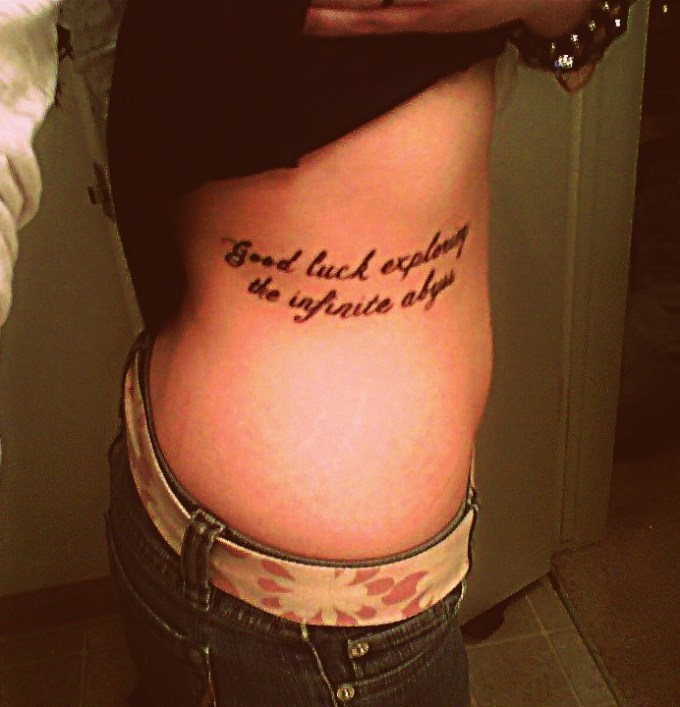
I once wrote a really long rant called “Llyod Dobler is a Made-Up Person.” The crux of the rant being that Lloyd Dobbler, the romantic, boom box-wielding idiot who swept Ione Skye off her feet by playing “In Your Eyes” in Say Anything, ruined romance for a generation of girls who thought that all guys should be that dreamy, but in fact none of them are. He’s completely made-up, and completely ridiculous. This is also true of the Manic Pixie Dream Girl. No one talks or acts like Sam in Garden State, and if such a person did exist, wouldn’t you just find her so annoying that you’d want to slap her?  I mean, this is just one of the annoying exchanges between the two lovebirds:

Andrew Largeman: Fuck, this hurts so much.

Sam: I know it hurts. That’s life. If nothing else, It’s life. It’s real, and sometimes it fuckin’ hurts, but it’s sort of all we have.

You know what else hurts? Movie dialogue that’s supposed to be deep and meaningful. But maybe I’m just being cynical. Obviously, some people like it:

adf638a0-f81d-0131-6db0-0aa0f90d87b43d59f7cf0b209dc57f01951ed4282860

(Hah! You two idiots got the same tattoo!)

I wish I could say that Sam says that line in a laid-back, “what-can-ya-do?” kind of way. But she doesn’t. She’s being completely serious. And that is the problem for the entire movie. It just takes itself so seriously and tries so hard to be poignant that it blasts right past “poignant” and goes straight to “dippy.” Take the scene where they are all swimming in the pool, except Andrew because he never learned how to swim at the school for mom-cripplers he was sent to, and he gets all philosophical on Sam, realizing that he was homesick for a place that doesn’t exist, and waxing, “Just because it’s a house doesn’t mean it’s a home.” Yeah, douchebag. You got sent away and wished you could go home, only to realize that home was not that cool. Ever hear that the grass is always greener? It’s called adulthood. I’d say jump in, but you can’t swim.

Despite all of this ridiculousness, Garden State has some high points. If I had the time, I would do my own “Phantom-Edit” and simply cut out Natalie Portman entirely, and have it be a cool buddy comedy about Peter Saarsgard (however it’s spelled!) taking Braf on an emotional (but weird) journey to get his mom’s jewelry back. Those, to me, are the best scenes of the whole movie. Like when they go to the hardware store to steal something only to return it for the cash, and encounter their deranged classmate who is embroiled in a pyramid scheme. Or at the hotel when they have to deal with the sex-crazed bell-hop played by Method Man who reveals that he regularly spies on the guests. Or the weird family who live at the bottom of the quarry… Ok, never mind. I would probably still edit that out.

The best part about that whole storyline was that there was no over-blown “come-to-Jesus” moment. Braf got the jewelry back, was kind of astonished that they had traveled around Jersey all day just for that, and Saarsgard, as most men would do in that situation, says, “See ya,” and is basically never heard from again. Had that been the whole movie, I could look back on it and say, “Now that was a quirky, little indie flick.” Instead, I look back and think, “He knew Natalie Portman for, what, a weekend? And he’s giving it all up for her?”

tumblr_n61pvrcKmx1rvnnvyo10_250

Like I said above, I do realize that this is mostly a matter of perspective, and there was a time when I thought this movie was really good. And there is the possibility that the countless indie copycats have made this one retroactively annoying. However, one thing I learned in all my screenwriting classes was that you have to write for the future. Unless you’re making The Wedding Singer, you really don’t want your movie to become dated in this way. And not by the clothes or music (because that soundtrack still holds up), but in the characters and their beliefs. If Zach Braf wanted to make a statement through Andrew Largeman, he shouldn’t have made one that would seem frivolous to anyone in their thirties.

When I was 17, I worked in a small, two-screen movie theater in Weymouth, MA, called the Cameo Theatre (note the English spelling, to connote that it was old, bot that it was fancy.) I made minimum wage, which at the time was $4.25 an hour, and each employee also got six free passes a month to go to the Cameo’s sister theater, which had actual first-run movies. The Cameo usually got the duds (We did play Alec Baldwin’s The Shadow first-run, so there’s that.) The employees, who were mostly 17 or 18 like myself, had an inside joke where we would drive by and yell, “Cameo Theater sucks!” at the top of our lungs during the summer when the doors were open. Despite the sucking, it may have been the best job I ever had.

Loc_Website_03302009_16

The corporate honchos at Patriot’s Cinemas, the Cameo’s parent company, did try to get movies that they thought would play well to the locals, as the Cameo was very much a neighborhood establishment. And since there were gaggles of teens around, in the winter of 1994, we got Reality Bites, the Winona Ryder-Ethan Hawke “romantic” comedy that was supposed to be the 90’s version of The Breakfast Club. Obviously, it failed miserably at that (just as it failed to bring the local teens into the Cameo), but for some reason, the fact that I was a ticket-taker for this film gives it a special place in my heart. Part of the reason may be because I invited a group of female classmates to come see it on opening night, and snuck them in for free, and they actually thought I was cool for a change. Yeah, it was definitely that. Certainly wasn’t the Lisa Loeb song.
For those who have forgotten this forgettable movie, here’s the skinny; Winona’s character, Lelaina, who was valedictorian of her un-named university, is a budding filmmaker and has a job as a gopher on a morning talk show. Now, I wasn’t valedictorian, and I don’t think any film major would come close to being valedictorian, but I majored in film, and I probably would have killed for that job back in the day. But Lelaina wants to be an artist, so she is filming a documentary in her spare time about… whatever it is her and her friends are not doing. Unfortunately, since she’s twenty-two and buying groceries with her Dad’s gas card, she hates her life and her job and has no money and no boyfriend, so she’s sad. What she does have is a friendship which is wrought with sexual tension with Troy Dyer, the dreamy do-nothing played by Ethan Hawke. Jobless and homeless, Troy and his sidekick, Steve Zahn’s Sammy, have to move in with Lelaina and her roommate, an aspiring Gap manager played by Janeane Garafalo (Allow me to channel my inner Chandler Bing and ask: “Could this cast be any more 90’s?”). While the four of them living together seems like a recipe for disaster, I think I would like to live in a part of the world where two recent college grads can afford the rent for an apartment that can comfortably house four pretentious idiots.
giphy

The plot thickens when Lelaina begins dating Ben Stiller’s Michael, after a car accident that occurred when she threw her cigarette butt into his convertible. The 1990’s lesson here? Smoking can be good for you! Michael works for “In Your Face,” a made-up-for-the-movie MTV, “but with an edge.” Michael is awkward and wears a suit, and is boning his love interest, so Troy instantly despises him. Tensions run high, until Michael shows Lelaina’s doc footage on “In Your Face,” and it’s been edited and MTV-ized to make it more commercial. Too commercial as it turns out, as Lelaina leaves him and her big opportunity and runs into the arms of Troy The Bum. After sleeping with each other for the first time after years of built-up sexual tension, Troy freaks out, they have a fight, and he goes on stage (because of course, he’s in a band) and sings the Violent Femmes’ “Add It Up,” which features the totally appropriate lyric, “Why Can’t I Get Just One Screw?” Despite the harshness of that, and the emotional unavailability, the pretentiousness, and the unemployment, Lelaina decides that Troy and his nasty brown shirt are just too dreamy, and tells Michael, who has a job and a convertible and really does care about her, to go screw. It was the 90’s.

Add to that the product placement, the pop culture references, Vicky’s AIDS scare, Sammy coming out to his parents, the alternative soundtrack (which, ok, is pretty awesome) and the broad characterizations, and what we basically have is a 99 minute episode of The Real World. But that’s just the surface-level stuff. There is slightly more going on here, if you choose to look closer.

This is Ben Stiller’s first shot in the director’s chair, and he may have been young-ish, but he was no fool. Despite all of what I said above, the movie does have heart, and it totally captures what was going on in young America in 1994. We had been told our whole lives that we were unique and we could do whatever we wanted in life as long as we had the passion and the drive, and the blah, blah, blah. But it’s kind of a lie, because not everyone is going to end up doing whatever they want, because otherwise nobody would clean toilets for a living, unless they just don’t have the drive, or that happens to be their passion. Still, I was a lot like Lelaina back then, except way more cynical. But I did follow my friends around with a video camera because I thought everything we did was so poignant and funny. And I had friends who were like Troy, only way less dirty. So, while it seems like these characters are all mere tropes, they seemed all too real to me. The scary thing is thinking about what came first, the tropes, or the actual people acting like that? Did Ben Stiller make a movie that mirrored real life, or did people act that way because it was instilled in us by pop culture?

And what’s really scary is that the characters still seem real all these years later. Here’s why:

  • I feel like Troy and Lelaina probably dated for a few years, through various highs and lows, until she grew tired of him not being able to commit to anything except a hobo lifestyle and they parted ways. She then went through her “fag-hag” phase, where she decided that no man could ever love her like a a gay man could. She finally did meet Mr. Right, who was pretty much an older version of Michael, while working her desk job, and lives with him and their two kids in the suburbs. She probably writes a food blog.

    images

    Indeed.

  • Troy Dyer drifted from job to job, supporting his drug habit along the way, and yet somehow always landing on his feet. Eventually he cleaned himself up and settled down and had a family. All of his friends thought he was amazing for pulling himself out of the gutter, when all he really did was stop screwing up his life. But people love a good yarn. One of my favorite movie lines of all-time, which may or may not apply here? George Clooney in Oh, Brother, Where Art Thou?I guess hard times’ll flush the chumps!
  • Even though the movie tried to paint Sammy as The Other for being “the gay  one,” he was by far the most normal one of them all, and his current life probably reflects that. And being a normal 40-something is a very cool thing to be these days.
  • Vicky Miner still works at the Gap.

But Michael Grates, the somewhat awkward exec played by Ben Stiller? That’s the guy that I’m interested in, and his character is why the movie settles well with me. I came up with this ridiculous theory while driving back from Vermont recently, and “Baby, I Love Your Way” by Big Mountain was on the radio. It’s totally just made-up B.S. on my part, but it’s my rant, so here goes:

Michael is the second-act version of the character that Stiller later played in The Secret Life of Walter Mitty (which he also directed and starred in). Walter is just as awkward, and single at his age, probably because people like Lelaina have walked all over him his entire life. Walter talked about his father passing away when he was 17, and at the time he had a mohawk and was an avid skate-boarder. But his father’s death forced him to grow up faster than he would have liked and start working to actually earn money (Not because his mother wanted him out of the house, which is how I came to work at the Cameo), so that’s why he had a good job at such a young age in Reality Bites, but dated a younger woman who represented a period of life that he missed out on. Yes, he did have Lelaina’s documentary footage edited to make it more mainstream, but that’s only because he was so much more mature than her that he realized her version would never fly. Maybe it was his longing to do something creative with his life that drew him to her, and was the reasons for his day-dreaming in Walter Mitty, because he was basically making little movies in his head. When the whole 90’s MTV craze thing ended, he then obviously changed his name to Walter Mitty and got a job as a Negative Assets Manager in the Photo Department at Life Magazine. I mean, it’s so obvious.

OK, that last part is a little far-fetched, but what I think it really speaks to is the kind of work that Stiller is drawn to. To him, and in a way to me, Reality Bites isn’t some delightful rom-com of twenty-somethings trying to make it in this topsy-turvy world. It’s a real coming-of-age story, because your 20’s is when you come of age, by making mistakes and learning from them and then, later in life, when you’re Walter Mitty, you can find a much better girl, who is unpretentious and actually funny instead of ironically funny.

And who is obviously Kristen Wiig.

if-you-dare-her-kristen-wiig-will-take-a-bite-out-of-this-dog-photo-u1

I think Michael/Walter made out all right in the end.