First, I want to thank both of the people who gave me some positive feedback on some of my recent posts. While I obviously enjoy positive feedback of any kind, written comments are always welcome, so that others can see that they are not the only ones reading these. I mean, there are so few of you. We might as well have a dialogue.

Anyway, since ’tis the season, I thought I would make this post about a modern holiday classic (modern classic… a new genre), Love Actually, a movie that almost everyone is probably familiar with, and one that can be kind of polarizing, even in my own mind (Was Andrew Lincoln being forlorn and lovestruck, or creepy and stalker-y?). When I first saw it, I had just gotten out of a long-term relationship that ended quite terribly, so the idea that love was actually all around, as Hugh Grant narrates at the beginning, was pretty much utter hogwash to me. My stance started to soften over the years, and I actually went through a period where my roommate and I used to watch this movie rather frequently, and not even always at Christmas. Now, having seen it countless times and over-thought it to death, I think I can speak honestly and  objectively about it. Well, maybe not completely objectively. It is a Christmas movie.

I will forego my usual plot synopsis on this one (dry your eyes), because everyone knows the movie, and there are about 8 love stories in here of varying levels of drama. There’s Colin, the obnoxious, young Brit who travels to America to meet woman because he thinks his accent will be cute over here (which totally works because he gets to sleep with January Jones and Elisha Cuthbert, and a Bond girl all at once), and there’s the other extreme of Emma Thompson and Alan Rickman, whose marriage is pretty much in the toilet. I will say that one of the reasons this movie has settled so well with me is that juggling 8 plot-lines in one movie is extremely difficult, because most screenwriters (myself included) have a hard time dealing with one, so Christmas cookies to Richard Curtis to being able to handle all that. I’ll let a little of the timeline-jumping slide because this film must have been a real bugaboo to  write and edit, and he did a great job when all is said and done.

Another reason this movie has settled so well with me is that, over the years and stages of my sanity, I have been able to identify with different characters. There were times when I totally identified with Andrew Lincoln’s love-sick sidekick character. Not because I was in love with my best friend’s wife, because that never happened, but just that the object of his affection was unattainable, and we’ve all been there, I’m sure. And yeah, it seems weird that he makes a video entirely of her, and his giant cue card expression of love  can be read as creepy. And what exactly would he have done if Chiwetel Ejiofor answered the door?

605576501e98c007_tumblr_lw7ua4QxpF1qa7ur0o1_500.xxxlarge

When I was thinking about writing this post, I thought about this storyline the most, because I’ve seen a lot of things written on it on the ‘nets. I decided that he wasn’t being creepy because we have no idea what the history is between him and Keira Knightley. Maybe he saw her first and his friend scooped her up. And it’s not like he had videos of her in the shower taken from their shrubs. In fact, from the dialogue between them, you can infer that he was keeping his distance after their wedding. She even confronts him on this, saying that she wants to be friends, even though she thinks he’s never really liked her. That’s why one of my favorite moments in the movie (and any movie) is when she is watching the wedding video he made and that realization washes across her face when she finally grasps that he is in love with her. Now, she is left to wonder what-might-have-been, and he is left to think, “Crap. She knows.” And that friendship she was asking for is probably out the window. Lincoln gets his closure in the end, in my opinion, because he does tell her how he truly feels, and it’s not like he kidnapped her or anything. He had his cathartic moment, she gave him a little kiss to say, “Dude, you’re all right, and if I wasn’t married, I’d hit that.” And he realized that, as he said, it was, “Enough.” He is allowed to move on with his life.

Which is probably more than we can say for Emma Thompson’s rather sad housewife. They really pile it on this poor woman, even going so far as to make the actress wear padding to make her look more like a middle-aged homebody. They also make her the sister of Hugh Grant’s Prime Minister just to make her life seem more meaningless. Fortunately, he shows up just in the nick of time to lift her spirits in one of those Festivus Miracle-type moments.

But what really happened here? Well, Alan Rickman is blatantly told by his new assistant that she lusts after him. After several advances, his resolve begins to weaken, and he buys her an expensive necklace, which Thompson finds in his coat pocket and thinks is for her. When she opens her gift and finds a decidedly less-expensive CD, Thompson knows what’s going on. We then see the beautiful assistant in her bedroom, in her underwear, the bed un-made behind her, putting on the necklace. Now, I’m no sleuth, but it looks to me like Alan Rickman is schtupping his secretary. And at the very least, he bought her a very expensive necklace. My young, naive self used to think that he stopped just short of actually sleeping with her, but another part of a movie settling with you is that now that I’m older and wiser, and grumpier, I think they totally did it. Either way, it’s not good, and let me say right here that Alan Rickman is probably the only person awesome enough to play this part and not make you totally hate him.

TFAdriver

Another thing my older self does now that my younger self did not was relate to Emma Thompson a little more. When she confronts her husband about the necklace that she did not receive, she wonders out loud to him if the necklace was “just a necklace, or if it’s sex and a necklace, or if, worst of all, it’s a necklace and love.” The “worst of all” part is the part that gets me. This is a woman who is married this man, has two children with him, and probably believes her life to be complete, but now knows that he either had an affair or contemplated it. She then asks him if he would stay in the marriage, knowing that, “life would always be a little bit worse.” That’s the real bummer, isn’t it? Much like Andrew Lincoln and Keira Knightley, Emma Thompson’s life is different, and “a little bit worse” to boot. Now, she obviously stays with him on some level, because she picks him up at the airport at the end, but when he asks how she’s doing, she repeats over and over that she is fine, although she is clearly not. Clearly, her life is a little bit worse.

But the one “love” story that every Matt Dursin stage can identify with (especially the older, wiser, grumpier one) is Bill Nighy’s aging rocker, Billy Mack. Apparently, in England, the #1 song on the charts at Christmas is a big deal, and this year, Billy is trying to make a comeback by changing the lyrics to The Troggs’ “Love is all Around,”to “Christmas is all Around.” Even though he knows that this is a completely ridiculous idea, he go ahead and promotes it all over the country, making fun of his portly manager, Joe, every chance he gets. After Billy does attain the #1 song on Christmas, he gets invited to a glamorous party at “Elton’s,” who is obviously Elton John, leaving Joe to celebrate the holiday alone. Billy soon realizes his mistake and leaves the party so he can spend Christmas with Joe, realizing that Billy has spent the majority of his adult life with him, and that Joe is, in fact, the love of his life. They decide to get drunk and watch porn to celebrate. Forget “From here to Eternity” or whatever. This may be the greatest love story in the history of cinema.

e50928af-59a7-4872-8197-88a1115ca8fe

On the DVD commentary, Richard Curtis explained that the inspiration of this storyline came from his relationship with Rowan Atkinson, who was famous for playing Mr. Bean and makes a hilarious cameo in “Love Actually” as the sales associate who excessively wraps Alan Rickman’s scandalous necklace. Curtis said that after working with Atkinson for years, and staying in hotels with him and sharing so many hours together, he realized that they had spent more time with each other then their own families. And he wasn’t lamenting it at all, because he also realized that he truly loved Rowan in a very real sense. Not romantically, but truly and probably deeply. Anyone who has life-long friends, as I have, can understand this kind of bond that develops over time. I have people that I have been good friends with for over 30 years, and it is hard for other people to understand that kind of love. But it’s there.

Supposedly, the ancient Greeks had six words for “love,” representing the various kinds. For example, “Agape” meant “a love for everyone,” while “Eros” translated roughly to “sexual “passion.” I think Love Actually covers them all and more, between Billy Mack and Joe, Liam Neeson and his step-son, or Laura Linney and her love for her brother. It also adds in a love for Christmas. There are so many times in the movie where the characters realize that Christmas is a time for love, and that’s kind of like The Force binding the universe together.Love-Actually-250x250

One of Andrew Lincoln’s cards to Keira Knightley says, “At Christmas you tell the truth.” Maybe it is this Christmas honesty that makes it hard for even someone like me to be grumpy and analytical about this movie. This one was good when I first saw it, it was good a few years later, and it’s still good, no matter which Matt Dursin is watching.

Last night, I put in the DVD of Return of the Jedi, and I was immediately awash with feelings of nostalgia for the first time I saw that movie in theaters back in 1983. My whole family went, and it was a packed house, and what I remember most (I was only 7) was how cool it was when the whole audience erupted in applause when the title screen appeared the music of John Williams filled their ears. It was probably my first time experiencing one of those shared moments like that. I imagine it will be a similar feeling in about a week, when The Force Awakens plays to a hungry audience. (**2022 Update: It wasn’t**)

Then, harsh reality struck; I’ve had a feeling like this before. Strangely similar, in fact. Actually, almost exactly the same amount of anticipation I am experiencing now came over me in 1999, when everyone I knew was talking about the first new Star Wars movie since Return of the Jedi: The Phantom Menace. Yes, perhaps the worst settling movie of all time.

Over the ensuing sixteen years, I’ve heard a lot of differing opinions of this movie, as well as its two sequel-prequels. I’ve known people who are so mad that they say that they don’t even exist, or that George Lucas raped their childhood.  Those are one extreme, obviously, because I’ve also come across people who think that they were okay, and if you take the entire story (all six of them) as a whole, it’s an epic hero’s journey. And when I saw The Phantom Menace re-release in 3-D a few years ago, my fellow theater-goers applauded at the end.  Perhaps because it was over, but it was still applause.

In some circles, the Star Wars prequels probably evoke more emotion than any film series in history.  People certainly talk about them, positively or negatively, more than any saga in my life (maybe even the original Star Wars trilogy.)  But what really was going on there?  Certainly because of how beloved the original trilogy is, the new trilogy had an uphill climb anyway, but not only did they not live up to the expectations, the prequel trilogy rolled down the hill and crashed.  But why?  And more importantly, how?  Everyone clearly has their own opinions, but I think enough time has passed now, and with three new films on the way, the first of which will be here in a matter of days, that it’s time to cut open the body and examine the cause of death. And thus, I give you the Biggest Burrito Movie of them all: Star Wars: The Phantom Menace.

Basically, The Phantom Menace runs off the rails two sentences into the opening crawl.  The Trade Federation?  The planet Naboo?  Who the Hell cares?  After a few minutes, we see our heroes, the Jedi Knights, one of them being young Obi-Wan Kenobi, whom Star Wars geeks should actually be happy to see.  There is a mention by the cowardly villains that the Jedi are bad news, although we don’t really know what great fighters they are yet.  They attempt to rub the Jedi out, but obviously fail (To think, all the needless suffering could have ended right then.) Obi-Wan and his Jedi mentor, Qui-Gon Jinn, flee the evil frog guy’s ship and retreat to the planet Naboo below, which is apparently a planet we are supposed to care about because this Trade Federation is somehow repressing them.  Things go from bad to annoying as the Jedi soon encounter and mysteriously befriend Jar-Jar Binks, one of the most reviled characters in over a century of cinema.  Jar-Jar takes them to his subterranean hometown of Gungan City, and they meet his king, Boss Nass, who basically sounds like Big Bird on smack.  None of this seems to have real purpose except to be an elaborate introduction of Boss Nass, a character that we see three times in the whole saga.

I’m going to break from the riveting plot synopsis to talk a little about Jar Jar Binks. Seriously, is there a more polarizing character in all of history? Love him or hate him (I hate him, but I suppose someone must love him), he represents all that is wrong with the prequel trilogy: he is clumsy, he blathers on-and-on about nothing, and even though he is seemingly pointless, it all works out for him in the end.

But, as I said, he is polarizing. Some people think he’s harmless, and some others (including this Reddit user) who think that he is actually a Sith Lord who is pulling all the strings behind-the-scenes, and that Lucas’ master plan all along was for him to be revealed as the big baddie, until everyone simply hated him and never wanted to see him again, so George shoe-horned Count Dooku in. While the Jar Jar Theory couldn’t have been much worse than what they actually did, I’m glad they didn’t go that route. There was really no need to give Jar Jar any more screen time. And fear not, Jar Jar-haters. J.J. Abrams has heard your plea, and he has stated that the reviled character will not be appearing in The Force Awakens. So who cares if he was a Sith Lord or not?

4279fa32ca06a81ab8e167b3de2d3633

As is the theme with the entire film, nothing of note happens and Jar-Jar and his Jedi companions head back to the surface to rescue the Queen of Naboo, Amidala, whom we were told was a good person in need of rescue earlier in the movie, but we never saw any evidence of wrong-doing, so who knows?  They actually very easily rescue her, and decide to take her to the planet Coruscant, where she can stand before the Imperial Senate and ask them to tell the evil froggy bad guys to basically stop being evil. Based on what we’ve seen so far, the two Jedi were probably enough to whip the bad guys and their stupid droids all by themselves, but we have a lot of time to fill here.

Long hours seem to pass, and the end result is that our heroes are attacked and must land on Tatooine, the future home of Luke Skywalker, to repair their ship. Qui-Gon then makes a twisted deal with a flying rodent named Watto for some spare parts.  The deal involves Watto’s slave boy, Anakin Skywalker (the future Darth Vader), whom Qui-Gon has deduced is The Chosen One, and will become the greatest Jedi ever. Anakin, despite being a toddler, is somehow a great pilot, so he is tasked with winning the ship parts in what amounts to a really long NASCAR race, complete with incredibly annoying Chris Berman-like commentators. The similarities are so rich, they should have just gotten him to do the voices.

As part of Qui-Gon’s compulsive gambling, Anakin wins the race, the parts, and his freedom, and is convinced to leave his mother to go with these virtual strangers to Coruscant to learn the ways of The Force.  He says good-bye to Mom and all the other slaves (who Qui-Gon decided weren’t worth the effort. I guess Anakin literally is The Chosen One), gets on the ship and is off to meet his destiny.  He begins to form a bond with Padme, who is apparently the Queen’s hand-maiden, although anyone familiar with the casting of the movie knew right away that it was all a big farce and that Padme is in fact the Queen, since we were all told that Natalie Portman was playing a Queen. There are apparently whole websites devoted to fans theorizing when it was Portman and when it was Keira Knightley and I guess Rose Byrne. Personally, I’m not worrying about it (or even linking it. Sorry.)

When they reach Coruscant,” the Queen” pleads her case, although nothing seems to come of it (again.) Meanwhile, Qui-Gon asks the Jedi Council if he can train Anakin, but they don’t believe he’s anything special, so Qui-Gon reckons he’ll do it anyway. So nothing comes from that meeting, either.

giphy (1)

Amidala then decides, although she’s not really the Queen (or is she?), that she must return to her repressed home planet and save it from the evil frogs.  The Jedi are instructed by their bosses to return with her to keep her safe, and they decide to bring the decidedly-unspecial Anakin with them. So basically, the same poor assholes that just flew across the galaxy and sat around on a desert planet forever in order to get to Corusant have accomplished nothing and now have to turn around and go back to fight a battle that they probably could have won before they left and spared us a whole lot of talking. And wipes.

The Battle for Naboo is actually the best part of the movie, although two-thirds of it is not very good.  The battle unfolds on three stages, with some Naboo pilots waging war in space, trying to knock out the droid ship, which is no Star Destroyer, let me tell you. This battle isn’t very good because we don’t know who any of these pilots are.  In the second battle, we see Jar Jar Binks, suddenly a general, leading his fishy friends into combat against said droids.  This is also not very good because it has Jar Jar on the screen, and I would rather gouge out my eyeballs with a light saber than watch him fumble around on a battlefield, and yet somehow still take out several droids.

The third part of the battle sees Qui Gon and Obi-Wan battle Darth Maul in probably the best light saber duel ever seen.  It is something to marvel, and it would probably be remembered more fondly if there wasn’t two hours of crap before it.  Ray Park as Darth Maul almost single-handedly saved the whole movie, and he was on the screen for all of five minutes and didn’t even have any real dialogue. His voice was dubbed over, and even that was only three lines. And remember what I said earlier about Boss Nass having all that time? Couldn’t we have cut a few chunks and given them to Darth Maul?

Still, for the brief period he’s on screen, Maul flips around, his double-sided light saber flashing like crazy, kicking the hell out of Obi-Wan and then killing Qui-Gon right in front of his helpless pupil, prompting the requisite Star Wars cry of “Nnnnnooooooo!!!!” It’s just too bad that there was no build-up to this duel, no prior meeting between Maul and Kenobi, and no reason to believe why this guy was a bad guy other than he wears a black cape.

Meanwhile, little Anakin manages to get into the space battle, flies his ship into the hangar of the droid ship (the same one that about 20 Naboo fighters have been trying to destroy) and ACCIDENTALLY fires his torpedoes into the hangar wall, naturally starting a chain reaction that destroys the whole ship, thus rendering all the battle droids inert (in typical sci-fi cop-out fashion) and simultaneously ensuring victory for the Gungans, as well.  I could have almost bought all that as simple feel-good cheese, if Anakin didn’t actually say “Oooops” after he fired the torpedoes.  Somehow, even though he was made aware of the entire mission, the fact that he made it into the main bad guys’ ship and didn’t actually mean to blow it up made the whole thing even worse.

In the aftermath, Obi-Wan, having cut Maul in two but somehow not killing him, swears to his dying master to train Anakin in the ways of The Force. Then, the soon-to-be Emperor takes his place as Chancellor of the Senate, although I’m not sure if we’re supposed to know that, and Naboo is, well, about as irrelevant as it was at the beginning. We do learn, however, that even though Obi-Wan destroyed one Sith-Lord, that “always two there are.” Sith Lords are like these movies: one isn’t bad enough.

Unfortunately, like Anakin himself, this one bad movie started the whole series down the path to the Dark Side. The problems with this movie are many, and as I stated earlier, they start right at the opening crawl. “Crawl” is also an appropriate term for the movie’s pace, as it is basically a lot of people talking between wipes. Seriously, it’s like a child’s Powerpoint presentation. The few scenes that don’t involve a nice, long chat are imbued with childish Lucas tropes, like the young hero-in-training following the lead of the wise, old master who can act circles around him.

But even with all that, my main problem is that it could have been a lot better, and if George wanted to make it different than the original trilogy, he could have easily done that and accomplish all his story goals. He could have had Darth Maul do bad things, like hurt the people of Naboo, instead of just saying that they were being hurt. He could have had the Jedi do good things, like, free slaves. Last I checked, slavery was not cool, but when presented with the option, Qui-Gon Jinn clearly states, “I did not come here to free slaves.” Wha-huh? What kind of hero is he, anyway? Why let a planet full of slaves stay enslaved, but take one stupid kid with you? Basically, when your main character doesn’t want to free slaves, your main heroine keeps putting her lookalike hand-maidens in danger, and the child who is supposed to be the future savior of the universe is an annoying brat who wins battles by accident, it’s kind of hard not to root for Darth Maul in this one. Well, I guess those three minutes or so were worth it, right?

tumblr_mi9hzpwGkd1rj1d5oo1_500

As I said at the beginning, however, I was really, really looking forward to this movie when it came out, similar to how I feel now about The Force Awakens, and that scares me a little, but it would be tough for it to be as bad as Phantom Menace.  While I think that anticipation made me gloss over a lot of these faults at the time, there were certainly plenty of them. That is probably why it settled so badly. It was a long way down.

One simple sentence: “I don’t like my job, and I don’t think I’m gonna go anymore.”

Make sure you put the accent on “go,” as Ron Livingston’s Peter Gibbons did in the 90’s workplace comedy brought to us by the masterful Mike Judge, Office Space.

This isn’t a movie that I have recently re-discovered, like some of my previous posts, but this is one that was always near-and-dear to my heart. When I first saw it in 1999, I loved it for the corporate zaniness, the Superman III-referencing thievery, and the awesome printer beat-down scene. But it was released in 1999, and I was just a spry 22 year-old, cock-eyed optimist with dreams of becoming the next Tarantino. I was actually still working two part-time jobs at the time, so I really couldn’t identify with the premise. In fact, even when I actually got a “real” job later that year, I didn’t have to deal with the cubicle-Hell madness that Peter and his colleagues do in the movie.

Alas, it is 2022, and I stand before you a man of 46, my job has changed a few times, and I have gotten a little more Office Space in my life than I ever wanted. I don’t have a boss like Bill Lumberg, but I am waiting for the day when I am asked to move my desk into the basement like poor Milton. As it is, I have an office that is basically a server room, and I do have a red Swingline stapler.

stapler

So, what’s all the hub-bub about? Well, Office Space follows Peter and his hapless co-workers , Michael Bolton and Samir Nagheenanajar (two of the best character names in movie history) as they trudge through life at Initech, a software company that is in the process of updating all their bank software for the year 2000 switch (remember that whole fracas?) Peter is annoyed at the clamor that arises when he makes one minor mistake, like not attaching a cover sheet to his TPS reports, and for being asked to work on the weekend. Meanwhile Michael Bolton has daily squabbles with the office printer. Samir is equally unhappy, but more because no one can pronounce his name.

tumblr_mfwcwqPRSC1s1kqrno1_500

To try and alleviate his malaise, Peter’s girlfriend takes him to an Occupational Hypnotherapist, who tries hypnotizing his blues away. Unfortunately, right as Peter is falling under, the hypnotherapist has a fatal heart attack and dies, leaving Peter in a happy haze. He awakens the next morning, er, afternoon, to several messages from his boss, asking him why he isn’t at work. He also receives a call from his girlfriend, who was wondering the same thing. Peter simply responds that he didn’t feel like going in. While she berates him for flaking out, he simply hangs up on her, effectively ending the relationship (very effectively.) Peter then hilariously falls back into bed while she screams into his answering machine that she’s been cheating on him.

The following week, Peter still forgoes work, deciding instead to courageously ask out the local waitress, Joanna, played by Jennifer Aniston in full-on Friends mode. It is during this date that we learn of Peter’s epiphany: he doesn’t like his job, and he doesn’t think he’s going to go anymore.

Meanwhile, Initech has hired two consultants, “The Bobs,” played brilliantly by John C. McGinly and Cheers‘ Paul Wilson, to trim the fat at the company. As they go through the staff, they determine that Michael and Samir are expendable, and Milton, the mumbly, stapler-obsessed office wierdo played by Stephen Root, who was laid off but still receives a paycheck, will no longer receive it, so the problem “will work itself out.” Oddly enough, even though Peter, in his newfound zen-state, told them how much he dislikes working there and how he hates having 8 bosses and how no matter how hard he works, his pay never increases, The Bobs feel he’s worthy of a promotion.

Now super-angry at the company, Peter, Michael and Samir pull the old “Superman III” heist, where they run a virus in the company’s computer system that will drop tenths of a penny into an account several million times, so that over a few years they will make a lot of money. This, of course, backfires, and the transfer takes hours instead of years. After getting blamed by his friends for the whole debacle, Peter decides to return the money and take the fall. Fortunately, Milton finds the returned money before his bosses do, and sets the building on fire, as revenge for his boss stealing his red Swingline stapler (among other things. Maybe being fired, but probably the stapler.) Peter ends up taking a job in construction, enjoying the outdoors. Michael and Samir go to work for the competing software company, while Milton ends up on a beach resort, having absconded with all their money.

But that’s just the surface stuff. The part that really resonates with me now that I missed back in ’99 is the conversation Peter has with the two consultants.  After telling them comically that he comes in 15 minutes late every day, and then spaces out for an hour, staring at his desk to appear to be working, the conversation then turns to what I feel is the film’s main message, as much as a comedy can have a message (Remember, nothing is written into a movie by accident.) Peter illustrates that the reason he hates his job isn’t because he’s lazy, but that he doesn’t care. As he so eloquently puts it, it’s, “a problem of motivation,” meaning if he works really hard and the company makes more money, he still doesn’t see any of it in his check. He points out how annoying it is to have all 8 of his bosses come down on him for making one small mistake. And the part where I feel Mike Judge was really trying to get his point across, Peter closes his rant with:

That’s my only real motivation is not to be hassled, that and the fear of losing my job. But you know, Bob, that will only make someone work just hard enough not to get fired.

I won’t say that he is speaking for all of us, but let’s face, he’s speaking for a lot of us. I’m pretty sure that for every person who just loves their job, there’s one or two who are just doing it to not get hassled (or if you’re like me, for health insurance.) Think about it; how many people do you know who do their job just hard enough not to get fired, or because they’re afraid not to work, or most likely just for the money? What does it say about the world we live in when there are literally thousands of employed people who at this very moment are probably only working just hard enough not to get fired? And I’m not knocking them. They are probably all like Peter Gibbons in that no matter how hard they work, they won’t see another dime in their paycheck. This isn’t exactly an epic revelation, I know, but it’s still something that hasn’t been put into words quite as succinctly as it is in this movie. And when you think about it, it does kind of suck. The American Dream of getting a good education to get a job and get married and buy a house and have kids and then retire after 30-some years kind of seems wasteful when you may have spent most of that time working just hard enough not to get fired.

The movie tacks on a sort of Hollywood Ending by having Peter admit to Joanna that he doesn’t know why he can’t just go to work and be happy. Joanna echoes his statement by saying that’s just what people do. Basically, you find something you sort of like and soldier on. Now, according to the DVD extras, Judge faced a lot of studio backlash while making this movie, and I’m willing to bet my meager salary which doesn’t go up when I work really hard that these lines were shoe-horned in at the behest of the 20th Century Fox people, who just needed their hero to not seem so bad. The weird thing is that Joanna also had a bout with her boss (played by Judge himself, in his most Hank Hill-iness) regarding her uniform. In a total T.G.I. Friday’s send-off, Joanna is required to wear 15 “pieces of flair,” or buttons to the non-corporate folks, on her person every shift. She gets spoken to for not “expressing herself” enough, because she is wearing only the required 15 pieces. Joanna is chastised for only doing the bare minimum, so for her, even doing what she’s supposed to isn’t enough. She eventually quits the job, expressing herself by flipping off her boss. However, at the end of the movie, we learn that she has gotten another waitress job at a competing restaurant. Presumably, there is no flair involved, but I still find it odd that they wouldn’t find something else for her to do. Maybe It was a comment on Jennifer Anniston always playing waitresses.

That’s not the final word on the matter, though. As I said, Peter takes a job in construction, and he gets a gig cleaning up the remains of the Initech fire. Michael and Samir stop by to check in on him, and it is hinted that he took the job just to make sure that there was no evidence linking them to the missing money. However, when they say that they are working for another software company, and they can get him a job there, he flatly turns them down. This, I feel, is how Mike Judge really wanted to end things. While Joanna and Samir and Michael have their lanes, and ended up pretty much where they were at the start of the movie, Peter is a changed man. He is smiling about working outdoors, having brought his lunch in a pail, and he presumably doesn’t have eight bosses. In a way, he took Joanna’s advice to find something he likes and soldier on, but it was a completely different type of work. A different lane, you could say. And the OT is probably pretty nice, so that whole work harder for no more money debate is out the window.

See, we still have to work for money, right? Office Space tackles that topic very smartly when the characters debate that silly test most high-schoolers take about what they would do if they had a million dollars. Michael rightly posits that the entire concept is ridiculous, because no one would put down janitor, because no one would clean toilets if they had a million dollars. Peter’s neighbor Lawrence, eloquently states that if he had a million dollars, he would simply do “two chicks at the same time, man.” Lawrence is obviously the smartest person in the movie.

lawrence-from-office-space

When Peter says that, if he had a million dollars, he would do absolutely nothing, Lawrence the Wise points out that you don’t need a million dollars to do that, as his cousin is broke and he “don’t do shit.”

I suppose that is what the movie has taught me as it has settled. It’s not about one man’s quest to do nothing, or a botched, Superman III-style heist, or even about three guys slaving away for a faceless corporation. It is about all that stuff, but also a lot more. The main idea is, as the tagline at the bottom of the poster says, “Work Sucks.” It sucks when you have to answer to eight bosses. It sucks to comply to the uniform requirements and still get criticized for it. It sucks that the magazine salesman, who is a former programmer for Initech‘s competitor, makes more money selling subscriptions door-to-door than he ever did as a corporate worker bee. It all sucks. Even the dream job is still hard work. So, what’s the answer? I’m not sure. Maybe find something you like and stick with it?

Maybe the studio had it right, after all.

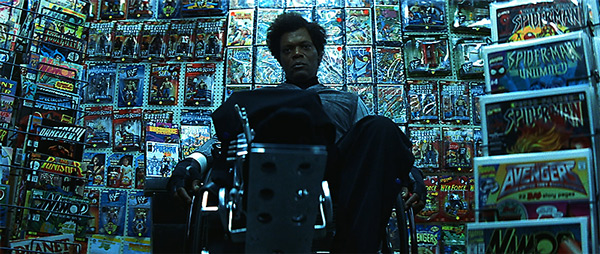
First off, I want to preface this by saying that I always loved this movie, making it a unique choice for a movie that settled, since it was always good in my estimation (and also, apparently, for its director. M Night Shyamalan cites it as his favorite of his movies, as well.) Even as a lapsed comic book fan in 2000, I understood the hero/villain dynamic that Shyamalan was going for, and I really dug it.  The cool thing about this is that I’ll talk about a movie that was great in 2000, and see how it looks now after all these super-hero movies that have come since then.

So, here’s the skinny on Unbreakable, if you haven’t seen it (which is ludicrous.) David Dunn, played subtly by Bruce Willis, is a down-on-his-luck everyman. We learn immediately that his marriage is on the rocks and his life is kind of in the gutter. However, things take a turn when the train he is on crashes, killing every passenger on board (That sounds awful, but bear with me.) Miraculously, Dunn is not only alive, but he emerges without a scratch. This makes Dunn’s wife, played by Robin (Wright) Penn, feel sort of bad and come around a little bit, and his son to start hero-worshipping him like crazy.

Dunn soon receives a mysterious message from Elijah Price (Samuel L. Jackson), asking him if he’s ever been sick. Elijah was born with a rare and unfortunate disease called Osteogenesis Imperfecta, which is smart-people talk for “his bones are like glass.” Elijah, who has had 54 broken bones in his lifetime, believes that if there is someone like him in the world, then there must be someone on the opposite end of the spectrum, i.e. someone who can’t be hurt, and he has been on a quest to find this person. Elijah also is obsessed with comic books, even owning an art gallery comprised entirely of original comic book art (Something I am extremely jealous of). This obsession is what inspires his quest.

Mr. Glass is not in Near Mint Condition

Mr. Glass is not in Near Mint Condition

Jackson even has paragraphs of dialogue in the movie about how comics are our modern-day mythology, which is ironic considering the pivotal role he would later play in the Marvel Cinematic Universe. When they meet Elijah tells David that that he feels that he is more than an ordinary schmoe. That he survived the trainwreck because he is, in fact, the person he has been looking for. David obviously thinks that he’s crazy, but Elijah drives his point home, asking him if he’s ever been injured, and David’s son reveals that he was injured in a car accident in college, which derailed his professional football career. Dunn also works as a security guard at the local stadium, and Elijah points out that he wanted to protect people. The injury is the maguffin, however. Elijah pushes the matter further after Dunn’s wife becomes his physical therapist, and it comes out that she didn’t see herself with a pro football player, since the violence of the sport is contradictory to what she does.

Meanwhile, David starts to believe Elijah while lifting weights in his basement, when he realizes he can lift hundreds of pounds, and asks his boss when was the last time he had taken a sick day (He even gets a raise out of it, since he never has.) After analyzing all of the pieces of the puzzle, and stumbling upon a Sentry-Man comic, Elijah realizes that Dunn faked the injury he had in college to get out of going into professional football, because he wanted to stay with his future wife. The only other time David was sick was that he once almost drowned, and Elijah chalks that up to water being his kryptonite.

Eventually, Elijah convinces David to go to a public place where there are lots of people, and see what happens. He goes to a crowded train station. and it is dramatically revealed that David can detect criminals when he is near them. A vision of a janitor leads David to a home that the janitor has invaded. David subdues the criminal and frees the children he had taken prisoner. It is true. He is a hero.

Of course, Shyamalan always has a twist at the end, and in Unbreakable, the twist comes when Dunn shakes Elijah’s hand and discovers that Elijah himself is an arch-criminal. Turns out, Elijah had been creating tragedies in search of his counterpart, the person who is his exact opposite. It was Elijah who caused the train wreck that brought David to his attention in the first place. In the one part of the movie that’s a little disappointing, Dunn calls the police and has Elijah arrested for his crimes… off-screen. In a total Joker-esque moment, Elijah is happy to finally know his place in the world, as David’a opposite, because in all comics, you always know who the villain is, because he is the exact opposite of the hero.

Of course, that is just one instance of the comic similarities in this movie. Elijah is most definitely patterned after The Joker. The end title screen even says that he was committed to an institution for the criminally insane. They might as well has said Arkham Asylum. Even Elijah’s distinct purple color palette, and the way his hair is cut kind of askew point to the Clown Prince of Crime, and there is a line in the movie that says that old-school comic book villains are always drawn slightly disproportionate than normal characters, to better illustrate their skewed perspective. Let’s face it, though; if you had broken that many bones in your life, your perspective would probably be pretty messed up, too.

Elijah’s color palette isn’t the only one that stands out, as every person in the movie who is revealed to be a criminal is shown in vivid color, while the rest of the movie is rather muted. The janitor wears a bright orange jumpsuit. The fan who has snuck drugs into the stadium that David pats down (played by Shyamalan) is wearing a bright blue jacket. And the fan who David thinks is sneaking a gun into the stadium is wearing a bright green camouflage jacket. This is meant to reflect comic book coloring, which use distinctive colors to call attention to the action in a panel.

David Dunn is also reminiscent of a comic book hero. Even his name is a reflection of many comic heroes’ real names, which use repeated consonants at the beginning (Peter Parker, Matt Murdock, Bruce Banner). He also wears a green rain poncho with “Security” on the back with a hood, which is meant to resemble many comic heroes, like Green Arrow or The Spectre.

I'm Pseudo-Batman!

I’m Pseudo-Batman!

Nothing in a movie is by accident, and beyond the characters, the movie itself is reflective of a comic book. There are a lot of long tracking shots (almost all of them, actually), to mimic comic book panels, which are supposed to have one action per panel. There are a lot of shots, like Elijah’s birth scene, that are shot at mirrors or through windows, or reflections in the glass frames at the art gallery, to bring home the “Mr. Glass” aspect of Jackson’s character. These are the kinds of things that pop out when you let the movie settle and watch it again (or do some research on IMDB, if you’re interested.)

The thing that I find really interesting is that this movie says more about comic books heroes and villains than any one that Marvel or DC has made. I get that they are trying to make blockbusters and Shyamalan was trying to make something a little more thought-provoking, but why can’t we have a bit of both? Maybe that’s what they were going for with Man of Steel, because clearly they were trying to do… something, but whatever it was, they failed. And as much as I like most of them, Marvel’s movies don’t really try to get very deep, especially with the villains. Loki gets a little character development, with the whole “I was adopted and my dad didn’t tell me” thing, but mostly because he was given three movies to do it in (and Tom Hiddleston is pretty awesome). Other than that, HYDRA is bad, the Chitauri were bad (and pretty useless), and Ultron was really bad (in so many ways.) At least they got The Joker right in The Dark Knight, and it really makes me wonder if Christopher Nolan is also a fan of Unbreakable.

“Marvel-porn” is a slang term I have heard in some circles in comics (Do NOT Google that, by the way), mostly by people who prize independent comics over all other forms of art in human history who think that Marvel books are heavy on action and big boobs and light on anything meaningful. As an indy creator myself, I sort of understand where they are coming from, and you definitely need to take what you do seriously, whether it’s creating comics or saving lives, Still, we are talking about comic books, and they are just entertainment. Even so, entertainment doesn’t need to be quite so vapid. I love the Marvel Cinematic Universe, but as far as comic book movies, Unbreakable nailed it better than any Marvel or DC movie, and it’s as true now as it was 15 years ago.

Be a real super-hero out and buy or rent Unbreakable on Amazon and help keep this the Dursin-est site ever.

Last week, I wrote about a movie that settled very well, like a meal you think about a few hours after you’ve eaten it and thought, “Mmm-mmm, that’s good eatin’,” while rubbing your tummy. Occasionally, however, as we all know, meals don’t settle very well. Unfortunately, movies are like that, too. I call these Burrito Movies!

So, for this blog post, I am going to write about a movie that didn’t settle well at all: Kevin Smith’s Chasing Amy. Unfortunately, this is the quintessential Burrito Movie, because I loved it while I was consuming it, but got mild indigestion when I watched it recently.

Let me preface this rant by saying that I feel kind of bad thinking this way. When I was an upstart college student, I loved Kevin Smith and all he stood for (which wasn’t much outside of his small New Jersey circle of friends, but still…) I loved that this guy put all his money and worked his ass off to make Clerks, a movie that gave hope to fledgling filmmakers everywhere in 1994, but its bad acting somehow seems so much worse twenty years later (And the less said about Clerks II, the better.) But as a freshmen in Film school in 1994, and one who had spent a lot of his prime high school dating years making goofy movies with his friends, I definitely respected what Smith had done. If nothing else, Clerks was a symbol of what could be done with hard work and some friends who were willing to humiliate themselves a little for you. I also felt a bit of a kinship towards the characters, as I was also a video store clerk at the time, and knew their pain all too well.

Three years later, Smith had the money and notoriety to make a “real” movie and hire “real” actors, like Ben Affleck and Smith’s girlfriend at the time, Joey Lauren Adams. While Clerks and its follow-up Mallrats were kitschy, little teen angst-y, 90’s rom-coms, Smith used Chasing Amy to get a little more serious. He tried exploring the dynamics of the male-female-male relationship when the female is not only a lesbian (at least, the movie goes out of its way to present her as such, instead of bisexual), but also has a somewhat shady past, and when the other male is the first male’s best friend and business partner. This was apparently inspired by a scene in Guinevere Turner’s Go Fish, where a lesbian falls for a man, and is shunned by the lesbian community. This ends up as one scene in Chasing Amy, but still, it was supposedly the inspiration.

When I first saw Chasing Amy, I was a college junior, and you would be hard-pressed to find someone filled with more 90’s angst than me, so I thought this movie, and especially Jason Lee’s Banky, was speaking directly to me. When his best friend (Affleck) falls in love with a lesbian (Adams), Lee is not only suspicious but downright anti-gay. I couldn’t see his problem with Adams being gay (maybe because I didn’t know any gay people at the time, it just never registered one way or another), but I could identify with Lee being overly annoyed at “losing” his best friend to a relationship that he didn’t agree with. I have had many friends that got involved with someone who I deemed bad news, and it was only in my advanced years (and after being the friend who was involved with the bad news girl) that I realized that you can’t, and should never try, to get involved, because no good will come of it. Your friend either has to come to that realization on their own, or be condemned to a life of misery. Or, just maybe, you are wrong and your friend is as happy as a clam. No matter what, the bottom line is get over it.

Lee does not. In fact, he gets right into it, digging up dirt on Adams, uncovering her high school yearbook(!) and discovering that her nickname was “Finger cuffs,” a sexual reference that indicates that she had a threesome. So, even though most guys may think that this is pretty cool, Affleck (and I assume, by proxy, Smith) is taken aback, as he arrogantly thought that he was the first man that Adams had ever been with. The real question is, who puts that in their high school yearbook?

downloadIn one of the movie’s funnier scenes, Affleck awkwardly tries to bait Adams into admitting to the Finger-cuffs story while they are at a hockey game. She begins blowing the incident off as high-school silliness, but when Affleck persists, she climaxes it by standing up and admitting to all who can hear that she did indeed have a threesome. The young man next to Affleck hilariously points out that even he saw that one coming.

This leads to the other interesting scene in the movie where Affleck asks his gay friend Hooper how to handle this situation, and Hooper tells him to forget about it. Basically, it is only the ego of a straight man that doesn’t allow for his lesbian girlfriend to have had sex with other dudes. It is certainly good advice. I mean, no man is going to get very far in life if he only wants a girl who is pure and chaste. I understand that wonderful Catholic boy Kevin Smith thought that a girl having a threesome in high school would be scandalous, but seriously? I don’t even care about what I did in high school, let alone anyone I’ve ever dated.

Still. in the world of the movie that Smith has created, this is a no-no. So, where does Affleck turn to for help next? The neighborhood drug lords, of course. Smith (as the affable Silent Bob), tells Affleck a story of a girl he dated, Amy, whom he loved but felt weird about her more-adventurous sexual history. He eventually ended the relationship, and has spent the ensuing years trying to find one as meaningful, or “Chasing Amy,” naturally.

I guess Affleck decides he doesn’t want to end up an overweight drug dealer like Silent Bob, so he calls both his ex-best friend, and his ex-girlfriend together and proposes a way to save both relationships, and I believe it’s pronounced “menage a trois.” This baffled me then, and it baffles me now. As I mentioned earlier, I have had points in my life where my friend was in a bad relationship, or there was a strain on the friendship, and never did I entertain the notion that I should have sex with that person. Not even a female friend! I’m not sure if Affleck thought that this would allow him to experience stuff like Adams had, or if she would maybe somehow enjoy this solution, or why he thought Lee would enjoy it, but that’s exploring the friendship/relationship dynamic a little too much. And even more baffling is that Lee does agree to it! It’s never explained if this is just something he wants to check off his bucket list, but it is insinuated that the two friends basically love each other (They do kiss.), so it’s s’ all good. Thankfully, Adams, the smartest person in the room, says no way, rightfully pointing out that this will not solve anything, and leaves, telling Affleck she will not be his “whore,” which in a roundabout way, is exactly what he was going for (“Hey, baby, why don’t you come over and bang me and my best friend? Trust me. It’ll be so cool! And it’ll bring us all closer together. Really.”)

The final scene is supposed to be the kicker, where a year later all three parties are at the same comic book convention but have gone their separate ways. Apparently Bros before Ho’s wasn’t a thing back then, because Affleck and Lee haven’t spoken in a year and have dissolved their business partnership as well, and they have a pseudo-conversation across the room, where Lee wordlessly wishes Affleck luck, and nods his head at Adams’ table, encouraging his old friend to go talk to her. Which is really stupid because she probably wants nothing to do with him, but he does it, anyway. He gives her a comic he has written about their time together (titled “Chasing Amy,” of course) They exchange pleasantries, and after Affleck leaves, Adams’ new girlfriend asks who that was, and she replies it was “just some guy I used to know.”

I think as a viewer wecamy are supposed to believe, because of the knowing glances exchanged, that it actually meant more and she misses him, but really, if this were real life, it probably wouldn’t. I’m sure if we could check in on Adams’ character now, Affleck would probably be blocked on Facebook. Hell, I’ve been through weirder stuff than that, and I barely think about it at all now. But that was the 90’s, man. We cared a lot, sometimes unnecessarily so. That’s probably why Nirvana was so popular. We cared so much about things that all we wanted to do is complain about them, and we didn’t even have internet message boards to do it on.

Now, let’s break it all down as to why this movie didn’t settle almost twenty years later. First of all, this isn’t a gay or straight thing, but a relationship thing. And it’s not even a romantic relationship thing, because we’re also talking about the relationship between Lee and Affleck. This is about people getting along. I am not anti-gay, like Lee’s character, but never in my life have I thought that having sex with a friend will save the friendship. And I’m a big Seinfeld fan. But the idea that he would be so bothered by his girlfriend’s past that he would propose a threesome to try and patch things up is not only kind of weird, but also out of left field (I get that she had had a threesome, so he wanted one, too, but really? He jumped right to that? What if she had pierced her genitals?). Now, you could say that Affleck was grasping at straws at that point, so I’ll let him have that one. But this was something that had come up in Clerks, as well, when Dante got extremely upset when he found out his girlfriend had given oral sex to 37 guys. Granted, that’s a lot, but why does Kevin Smith keep going back to sins of the past in his movies? Did he have some unresolved issues or what?

Now, I’m going to throw this out there, too, and I am sorry if this is offensive, but one of Smith’s unresolved issues may be some latent homosexuality, because as much as he likes to hide behind the veil of “Two guy friends can be in love and not be gay,” he tends to take it a little too far. Even in his Batman writing, he pretty blatantly put out there that Batman and The Joker were in love. He’s certainly not the first to do that, but he was definitely the first to just “out” the Joker in a DC comic. And not for nothing but that was a pretty terrible comic.

But back to the topic; Smith’s movies almost always have two male protagonists who are almost too close. I mean, there is someone I have been best friends with since I was in diapers, and once he went to a psychic and she said that he was my soulmate. While I do kind of believe her, because thirty-plus years of friendship will do that, I have never thought about this guy in a sexual way. Because he and I are not gay. And that’s all there is to it. But again, this was the 90’s. Gay marriage wasn’t even a real political debate yet. It would be seven years before I would go to my first pro-same sex marriage rally. The fact that Kevin Smith liked to write sexually-ambiguous male characters in all of his movies was just a charming little distraction. But now it jut seems woefully uninformed.

chasingamy_zps4b0757a8

It should be noted, I guess, that Kevin Smith’s Twitter was hacked last year, and the hacker sent out a “Coming Out” tweet to the world. The director later regained control of his account and said it wasn’t him, but that he was “bi-curious, not brave enough to commit.” You don’t say. You’ll commit to naming your daughter Harley Quinn, though?

I would also be remiss if I didn’t discuss the comic book backdrop of the movie. This in itself is a cool setting for any movie, because not that many movies have explored this world at all. The problem is that it’s just a backdrop and not much more, other than a convenient way for Smith to display some of his nerd cred. Affleck and Lee play comic book self-publishers who have struck it rich and have “sold out” to a major publisher, and have a TV show in the works based on their comic. This is obviously years before Robert Kirkman “sold out” and made himself millions by signing off on The Walking Dead TV show, paving the way for thousands of other comic book hopefuls who will never, ever get that kind of rich. As a comic book self-publisher, the very idea that someone would scoff at me for “selling out” to a major publisher is ridiculous, since the only way to not lose money in comics is to be with a major publisher (And sometimes, even that doesn’t work). Plus, in 1997, digital comics were a long, long way off, so the only way to get your book in front of anyone was to literally hand it to them. Adams definitely has a point when she rags on Affleck complaining about his success. And I quote:

Oh the cry from the heart of the real artist, trapped in commercial Hell, pitying his good fortune. I’m sure you can dry your eyes on all those fat checks you rake in.

It’s funny what sticks with you sometimes, and this quote, and the debate surrounding it, always struck a chord with me. On one hand, she’s right. Shut up and take your money. I’m sure Jewel never said, “Damn, this success is pretty nice and all, but I sure did love living in that van.” Affleck then asks if there is a hint of bitter envy, and her response is that if she sells two issues she feels “like John Grisham.” Another good line, followed up by the old “Comics books are just spandex and big tits” argument. But the one thing that this whole scene seems to be forgetting is that we are talking about the very small world of independent comics. Sure, I’m guessing there are a few artistes out there who wouldn’t “sell out,” but if the whole point of writing a comic is get it read, sinking thousands of dollars of your own money into one issue and sending it out into the world with your good intentions isn’t enough (believe me, I tried.). People have to hear about it before they buy it, and that is pretty hard to do unless you are with a major publisher. Adams also makes a comment that maybe she should “just sign one of those exclusive deals,” as if Marvel Comics was just banging down her door begging her to work for them, but she was ignoring them. This is when you realize that Kevin Smith really didn’t know what he was talking about, because a few years later, he did, in fact, have Marvel banging down his door asking him to write Daredevil, but, y’know, he didn’t have to sink any of his own money into that, because he’s Kevin Smith. At least he didn’t have Daredevil and Foggy Nelson fall in love with each other.

It should also be noted that we are talking about comics, and probably only a few thousand people in the entire world (at least, in 1997) even gave a shit.

Even all of this tomfoolery is not enough to make this movie not settle well for me. The real problem for me is the characters are completely unreal and actually kind of bad people. Adams, portrayed as the unrepentant slut, is actually the voice of reason in the film. Affleck comes across not only as an uber-pretentious artist who wants to write a meaningful comic book, but also as a prude who likes to think that he had converted his girlfriend, and is angry when he discovers that he’s not her first male partner (I don’t recall the movie ever really declaring if he is more upset that she had a threesome, or that he wasn’t her first. Either way, get over it, man. It was high school.) Affleck is also severely whipped by his lesbian friend, even before the relationship started, which causes tension between him and Lee, and even though Lee comes across as a total jerk in that instance, he kind of has a point.

Lee himself is just an angry asshole, and yet his is the performance that Smith’s fans seem to remember most, because he was probably speaking to them just as he was speaking to me. Despite the raunchy conversation he and Adams had in the bar, comparing sex injuries, Lee is portrayed as the sexless, joyless, sad-sack sidekick, who constantly and un-ironically throws around the word “dyke” to describe his friend’s girlfriend. Lee even humorously draws out a scenario, showing a nice, easy-going lesbian, a “man-hating dyke,” Santa Clause and the Easter Bunny, and asks Affleck which will get to the dollar in the center first. Affleck, either knowing his friend all too well or actually buying into his way of thinking, correctly replies “the man-hating dyke.” Lee’s reasoning is that the other three are just figments of his imagination. Jason Lee’s performance in this scene is about the only thing that makes it slightly less offensive, but it’s a wonder that homosexuals weren’t stoning Kevin Smith’s house for writing this kind of crap. Lee did this either to illustrate how blinded by love Affleck is, or how much of a prejudicial jerk he is. It’s too close to call, really.

tumblr_m6ewxmjBc91r5qiggo1_500

Like I said, I was an angry dude in the 90’s too, and even I would have only said that kind of stuff behind my friend’s back (y’know, like a real pal would.) He really just acts like a jealous lover when Affleck goes off and openly has an affair with another person on him. I guess this was what Smith was trying to say, but it never really came across well. It’s also pretty ridiculous to envision two men having such a strong bond that it elicits such emotion, and yet the whole friendship crumbles over this incident in the end.

But here’s what really gets me. When Affleck gives Adams a copy of his new self-published, non-commercial, starving artist-created comic, the audience doesn’t really get to see what’s inside. On the very last page, he writes, “In love, you have to put the individual ahead of their actions. It’s comprehension of the past, not condemnation, that neutralizes insecurity.”

Well, duh! That is maybe the best line of the whole movie, and it’s not even in the movie. Instead, the movie is stuffed to the gills with Smith’s signature, 90’s-staple, “This is how real people talk” dialogue. If this line was somewhere, anywhere, in the actual movie, and a few of the less racy lines were cut out, I would probably still really like this movie. Instead, the line of dialogue that comes up when you Google “Chasing Amy meme?” This nugget:

0f6af1eaf30719f7f9a6c118199f4b8c9bac7a4759a435ce579d97dbf7e6157b

Thanks, Kev. Proud to know ya.

I have written many times about how sometimes a movie has to settle before you can really determine its quality, like a meal. This is probably something that only people like me (if they exist) ever do, because I feel like most people watch a movie, mentally rate it on whatever scale they like, and then movie on with their lives. I have a hard time doing that. It may be because I know how much work goes into making a movie because I have worked on them. Or it may be because I over-analyze everything. Or it may be because I am a yutz.

Regardless, I like to analyze movies, and sometimes that can be good, because I see the layers in them, and sometimes that can be bad, because I see all the flaws. Still, i thought there was fodder here for writing, so I’ll step aside from the Fidgeting and Sighing for awhile and figured I’d try this out; namely, seeing how movies “settle.”

I thought I would start with a movie that has been on Cinemax a lot lately (I subscribe to basically ever movie channel known to man, mostly because I hate commercials.); Gary Ross’ Pleasantville, the 1998 black & white/color social study starring Tobey Maguire and Reese Witherspoon as teenagers who are transported into the world of a Leave it to Beaver-like sitcom. Sounds fun, right? A couple of 90’s teen siblings hung up on their rather meaningless lives get shunted into a sickly Americana life, and hilarity ensues. This is a comedy, right? It has Don Knotts in it!

When the movie came out on video in 1998, and I was working in a video store, that’s what I told people when they asked what it was about. You learn to give people elevator pitches because no one wants to hear the film school snob analyze every new arrival. However, there is a lot more to this movie, and a lot of it isn’t very funny. I should have told them about the movie’s portrayal of racism, human sexuality, gender equality, and censorship. There is also some book-burning, lots of references to sex, an extra-marital affair, and even an attempted rape, and that’s by the supposed “good” residents of Pleasantville.

The movie really gets started when forlorn David (Maguire) wants to watch his favorite show, “Pleasantville,” while his harlot sister Jennifer does not. They argue over a mysterious remote control left by TV Repairman Don Knotts, and the remote somehow transports them into the black & white show, and David and Jennifer must assume the roles of Bud and Mary Sue Parker, the “aw-shucks” siblings who are main characters on the show. I use the term “black & white” both literally and figuratively, as there is no color in Pleasantville, and the values of the townfolk are also pretty black and white (mostly white.) Also, the weather is sunny and 72 every day, the fire department only exists to rescue cats stuck in trees, and the sports teams never lose, or even miss a basket. Everything is quite pleasant, in fact.

Bud insists that they play their parts to perfection and not mess with the world of the show, but Mary Sue gets bored with the old-timey values pretty quick, and wants to get it on. Specifically with Paul Walker, who plays Skip, the captain of the basketball team. Skip happens to think that Mary Sue is the “keenest girl in school,” and they agree to go a date to Lover’s lane, which causes Bud to realize that this is *that* episode. However, this Mary Sue takes things a little farther than what is presumably pretty far in Pleasantville, and she ends up taking the basketball captain to the hoop. Skip, clearly wierded out by his first sexual encounter (and apparently, his first erection) drives home and sees a a single red flower in the bushes outside his house. Not only is it a cool metaphor because he has been de-flowered, but it is also the first hint of color since the movie shifted to the Pleasantville world.

Picture3

It isn’t long before other hints of color start showing up around town, as Mary Sue has started a sort of sexual revolution all by herself. She even has a heart-to-heart with her TV show-Mom, played by Joan Allen, whom she instructs in the ways of self-stimulation (I know that’s not her real mother, but it’s still kind of weird.) The color doesn’t just come from people getting it on, however. The teenagers around town also start discovering the library, and with Bud’s help, start reading books like Catcher in the Rye and Huck Finn. Bud also helps Mr. Johnson (Jeff Daniels), the town soda jerk, find his focus by giving him an art book after Johnson expressed an interest in painting. Subtly, Bud is moving away from the normal Pleasantville ideals.

There is also some sexual tension between Daniels and Allen, who has awakened her own inner Mary Sue. After trying in vain to cover up her now technicolor skin, she leaves her husband, played by William H. Macy (as only he can). She runs to Daniels and ends up posing nude for him as he paints a very colorful mural of her on the window of his diner. Then it all hits the fan. A little color was one thing, but a naked chick? You are stomping on the very morals this great country was founded on! What’s next? Public sex with animals?

pleasantville-painting-art-film

The coolest thing about the color is that it contrasts so well with the black-and-white. For 1998, it was a marvel of cinematic technology, as characters that were in color were digitally enhanced since they had to interact with characters who were in black-and-white. There was a lot of green screen (and in the case of Allen, green make-up) usage to make the characters stand out, like the girl in the red dress in Schindler’s List. Until Phantom Menace came along (unfortunately for all of us), Pleasantville was actually the most digital effects shots of any movie. So the movie was not only effective in what it was saying, but how it was saying it.

11_Umbrella

Interestingly, despite being the progenitors of all this color, Bud and Mary Sue remain in black-and-white. Mary Sue especially wonders why, since she claims to have had more sex than any of her high school brethren. Bud thinks it is more than just sex, and he is proven correct when Mary Sue actually gains her color when she stays up all night reading D.H.Lawrence, reading glasses and all. Bud himself goes color when he punches out a local bully who was terrorizing his mother. So, just like in the real world, having sex doesn’t necessarily “color” you, or change you, but doing something against your character. something good, can help you see the world differently, give you color.

Finally, Pleasantville mayor, played by J.T. Walsh (in his final appearance) calls a special town meeting, where he basically puts Danials and Maguire on trial for painting a colorful mural on the side of Daniels’ diner. In a shout-out to To Kill a Mockingbird, the “colored people” all must stand in the balcony to watch the proceedings, while the black-and-white folks can be on the main floor. While Walsh tries to dictate that only black and gray paint colors can be used, Maguire pushes him, and like Tom Cruise did to Jack Nicholson in A Few Good Men, finally gets Walsh to get angry enough that Walsh turns color, proving that even the most stubborn hold-outs must accept change.

In the end, the magic remote is repaired and Bud is given the chance to return to his real life. However, Mary Sure/Jennifer decides to remain in Pleasantville, where she is given a second chance. She decides that she can now go to college, whereas in the real world, she has spoiled that chance already by acting a certain way (read: slutty.) To me, that is one of the really interesting aspects of this movie; that sometimes the paths that we choose lead to unforeseen consequences, but we can change them if we want. Interestingly enough, I have chosen to see this movie differently than in my video store days, and I am happy I did. if you haven’t seen it in awhile, or ever, watch it again, and see how it settles for you.

Heroes Reborn Reviews… Reborn

Posted: September 30, 2015 in Reviews
Tags:

Back in 2006, a friend of mine asked me to review Heroes for his new website. I was a comic book guy, so I guess he figured I was the right man for the job. He bought me the season pass online, so I figured, what the hell? I think I only reviewed all of season I and half of season II, so I guess I wasn’t the right man for the job, after all. However, my reviews did gain some traction when someone on a Heroes message board found them, and was pleased that I posited that Heroes fans needed a name. There were X-Philes and Whovians, so why not Helixers? Unfortunately, I later found out what Helixer means in the Urban Dictionary. Not quite the same, but perhaps fitting.

Anyway, even with my reviews (or perhaps because of them), the show started to lose steam due to the writer’s strike, and eventually went down swinging, eking out four seasons before getting the ax. I wish I still had my reviews, because I don’t remember much about what I said, but I do recall thinking that the show had a lot of potential, but needed to be a little grittier. Maybe it got some teeth in the last couple seasons, but I stopped watching during season II and never really looked back.

Which brings us to this new show, Heroes Reborn, a continuation of the story sans most of the major characters. I watched it last week, and found myself asking several questions, like, “Can this show survive during what is now being called the ‘Golden Age’ of television?” and “Will it hold up now that we have all these other ‘nerdy’ shows like Arrow, Flash, and Agents of Shield?” And, the most important question, “Two hour premiere? Jesus.”

The first episode details what has been happening in the time since the original series ended. Apparently, Claire Bennet, the cheerleader played by Hayden Panettierre who had fast-healing powers, “outed” all the Evos (the new name for people with powers), and everything was awesome, until they decided to stage an Evos/Normal-folk Summit in Odessa, TX, where the Primatech lab that used to experiment on Evos was located, and someone blew the whole place up in a 9/11-style terrorist attack. Not only does this serve as a nice jumping-on point for the new series, but a convenient way to explain the deaths of most of the original characters in one fell-swoop, since they probably weren’t getting stars like Hayden Panettierre back.

Yeah, sorry. I'm busy.

Yeah, sorry. I’m busy.

Claire’s father, Noah (a.k.a. Horn-Rimmed Glasses), one of the few returning vets and who, in my opinion, was the heart and soul of the original, is haunted by that day, but has trouble remembering what exactly happened. He does some digging, and connects with old pal The Haitian, who gives him back his HRG’s and then inexplicably tries to strangle him. Noah fights back and The Haitian is killed in the struggle (so another original bites the dust.) With his dying breath, The Haitian reveals that it was Noah who put the hit out on himself if he ever came looking for answers. This is obviously quite vexing, so Noah continues to dig, and with the help of annoying conspiracy theorist Quentin Frady, returns to the scene of the bombing to find that the underground labs that he used to work in are still active, except that everyone who works there was very-recently shot up by Evo-hating radicals. Noah seems a little non-plussed by the shootings, and instead of helping his dying co-worker, he asks how he can find an Evo named Molly, who has the ability to locate anyone no matter where they are. Noah is a real cuddler.

Meanwhile, Evos are being persecuted all over the country since the bombing, and hapless high school Evo, Tommy, is trying and failing to get the hell out of there. Besides being whupped on by the school bully, Tommy is also being hunted by two nefarious evil-doers who, for reasons as-yet unexplained, want to kill all the “freaks.” When they threaten to shoot the girl Tommy is sweet on in front of him, he teleports them to a weird room, which is just a “place he thinks about when he gets scared,” which just happens to be the underground Primatech lab. They escape, and end up shooting all the dead people that Noah found whilst he was casing the Primatech lab. See, the room was a place that Tommy was taken as a child to be poked and prodded by Primatech scientists when he was discovered to have his weird powers. So it all connects. Sort of.

There are other disparate stories that I am sure will connects eventually. There is a sort of Underground Railroad in East L.A. where Evos can go to get safe passage out of the country. There is an Evo who uses his powers to win at the Craps table, which is pretty much the best use of powers that I can imagine, and he is being cased by Molly, the same Evo that Noah is tracking down. There is a very weird storyline where this girl in Japan can immerse herself in a video game to try and rescue her father. There was a masked Lucha Libre-style Evo who thought he could use his powers to help people like Spider-Man, which would have been a cool idea if they hadn’t killed him off. I am certain it will all be tied together somehow, and we will eventually find out who wants all the Evos dead and why, and it will all be wrapped up with a nice bow on it, but that’s a lot going on for one episode. The real question is; will it matter?

The strength of the original show, and any show, really, is how the characters relate and interact. These characters could be sitting in a bar drinking or working to unravel the great mysteries of the universe, but a show is only as good as the characters. Where the original show faltered, I feel, was an over-reliance on figuring out the whole “Save the cheerleader. Save the world” riddle, and what the helix was, and why Hiro had to look like he was squeezing out a baby (or a dump) when he used his powers, and not enough focusing on who these people really were. Hopefully, this time around they will figure that out.

Push!

Push!

One of the other issues I had with the original, and already have with this one, was that some of the plot points were not that original to me, having been an avid comic reader for most of my life. A lot of the ideas seemed to come right of the pages of my favorite comics, particularly the X-Men. They even had a Days of Future Past-like episode in Season II, and this new episode has people hunting the Evos in much the same way mutants were hunted in several classic X-Men stories, like God Loves, Man Kills. The William Stryker character who was the main villain in X-Men 2, and has since appeared in several X-Movies, first appeared in that critically-acclaimed graphic novel. The point is, now that comics are riding a wave of mainstream popularity thanks to hit TV shows and blockbuster movies, I wonder if other people will recognize some of the storylines that Heroes Reborn will try to pass off as original. Back in 2006 when Heroes debuted, there was no Marvel Cinematic Universe, and us nerd-lings were just starting to come out of the closet, so to speak. Now, everyone knows the stories, so Heroes Reborn will have to work that much harder to tell original stories and not resort to tropes. We shall see if the writers are up to the task.

Probably worth watching, anyway.

Probably worth watching, anyway.

Check out the full season of Heroes Reborn on Amazon by clicking here:

I should begin by saying I never saw any of the previous Mad Max films, so maybe my opinion is uninformed, at best. However, I feel that every movie should stand on its own and not have to rely on its predecessors to be good. Or at least make sense. In this age of re-boots, re-imaginings, adaptations, prequels, sequels, and generally no original ideas at all, I feel like the pat answer to the statement, “That movie sucked,” is almost always, “Well, you should (see the first one, read the book/comic, watch the TV show, see the original, etc.) The only thing I remember hearing about the original Mad Max franchise was from my beloved grandmother, who saw it, oddly enough, and told me that Mad Max Beyond Thunderdome was “all about pig-shit.” I was 9 at the time.

Thirty years later, I saw my first Mad Max movie, the much-bally-hooed Mad Max: Fury Road, and it left me with many, many questions. Perhaps the most important one was “What the Hell was up with this guy?”

MadMax-Fury-Road_vice_970x435

It’s Still Rock n’ Roll To Me!

I went in to this movie hearing a lot about what a giant leap it is for feminism or whatever, because Charlize Theron’s character is basically gender-less (or something. That may not be the real reason people were lauding it, but a movie that features a crazy, masked warlord taking several brides and keeping them in chains doesn’t seem to have many other good things to say on the subject of feminism.), so maybe I was expecting something a tad more cerebral. Basically, it is one long, pointless car chase. And I mean “pointless” in the most literal, direct sense. No point at all. And yet, I can’t in all honesty say that I disliked it because I found myself constantly laughing at the sheer absurdity that was taking place before me. This movie is almost literally a live-action version of a child playing with his toys in his backyard. If the child had a weird thing for suspended guitarists.

I have no problem with action movies that are light on story and heavy on destruction. I love Die Hard. I really like Predator. I even have a soft spot in my heart for the John Travolta/Nicholas Cage blow-’em-up-fest Face/Off. But as silly as it was, even Face/Off had a premise: Cop steals criminal’s face to infiltrate his empire. Needing a face, the criminal then steals the cop’s face and infiltrates his wife. Silly as it is, it is at least something to wrap your head around.

Here’s what IMDB wrote for the premise of Fury Road:

“A woman rebels against a tyrannical ruler in post apocalyptic Australia in search for her homeland with the help of a group of female prisoners, a psychotic worshiper, and a drifter named Max.” 

Wow. That actually makes it sound a lot better. I didn’t get most of that out of watching it. I really and truly just got that they drove a long way and then decided to turn around and drive back. And then dumped water on everybody. Spoiler warning.

Of course, the premise is just the premise, and it doesn’t get into the details, like why they spray-painted each other’s mouths silver, or why Max was even there and imprisoned. or who any of these people were there, and why we should care. But hey, it had some cool-looking cars.

iq3syn6py16tt-gif

I saw Fury Road with my friend and his girlfriend, and being a fan of Mad Max movies, she told me that’s just what they are about. When I said that movie was essentially about nothing, she agreed, and said that’s what they are all like. Bless her heart, she loved it And I envy that. Part of me wishes I could simply immerse myself in a movie for a couple hours and enjoy it. But there’s another part of me. There’s the part that enjoys movies so much that it hurts to see ones that are as bad as this. A cynical part that would find Fury Road appalling if it weren’t so unintentionally hilarious.

But the question that really will keep me up at night: was it “unintentional,” after all?

And what the Hell was up with this guy?

mad-max-fury-road-awesome-guitar-guy-1431710473

The world may never know.

Before the crap-tastic-looking reboot comes out this weekend, I wanted to revisit the previous attempts at bringing the First Family of comics to the silver screen. Then it hit me: I barely remember these movies at all. I kind of remember Jessica Alba taking off her clothes while she was invisible, and thinking that was pretty cool, but other than that…

Ahh, the memories...

Ahh, the memories…

So, to the internets I went, and discovered that, just as I thought, those movies are almost universally hated. And why not? There were some goofy moments, to be sure. Most of them involved Mr. Fantastic stretching and making fun of The Thing for looking like a rotting pumpkin. But it wasn’t even the goofy parts that ruined them, because, frankly, that’s just how they chose to play this one. It was a comic book movie, and the Fantastic Four comic has always been kind of fluffy. It was that the movies were just poorly written and basically uninspired that really bothered me.

The first Fantastic Four was made in 2005, back in the days before Disney bought Marvel and started putting out mostly good movies. Back then, we had seen a couple good X-Men movies, a pretty mediocre Daredevil movie, and a really, really horrible Hulk movie. So, the standards weren’t that high for comic book movie adaptations. Still, they mostly had the casting right, they had a cool villain in Dr. Doom (one of the coolest in all of the Marvel Universe), and all they had to do was tell the origin story. Seems hard to mess up, right? Yeah, right. Maybe they figured that they had a good cast, so they didn’t need a good script. In fact, the best part of the movie was pre-Captain America Chris Evans stealing every scene he was in. They should have just called it “Johnny Storm and Three Other Boring Super-Heroes.”

f4-ff-65

Still, like I said, that was the way they chose to play it, and the first movie, as silly as it was, at least was relatively harmless. Then they had to go and make the sequel. This time, there was no origin story to take up time, so the writers (including Mark Frost, the master scribe behind a few episodes of Hill Street Blues, something called The Deadly Look of Love, and unfortunately the new Twin Peaks series. Frightening.) had to write a full actual story. So they brought back Dr. Doom, introduced the Silver Surfer, and crammed in Galactus, just for fun. Well, not actually Galactus. Just a stupid cloud of smoke. I’m not sure who thought that a cloud would be cooler than a giant, planet-eating dude, but they were way off.

Once again, though, I will say that the casting of this one was very good, including a pre-Scandal Kerry Washington, Laurence Fishburne as the voice of the Surfer, and of course, Brian Posehn as the minister at the Mr. Fantastic/Invisible Girl wedding. Oh, I didn’t mention that there was a wedding storyline, too?  As if Galactus threatening to eat the planet and Dr. Doom up to his old tricks wasn’t enough to keep track of, let’s see if we can get these two kids hitched. (On a related side-note: why the Hell was Reed Richards so against marrying her in the first place? Hello! Jessica Alba? Doesn’t he know you gotta nail that down?)

Not to harp on this, but Rise of the Silver Surfer proves that the best casting in the world doesn’t mean the movie will automatically be good. There was a classic Saturday Night Live skit where Bill Clinton (played by the late, great Phil Hartman) claims that Ishtar was his idea. The quote, as I remember it, was, “I said, ‘Put Beatty and Hoffman out there in the desert, put a sarape on ’em, something good will happen.’ That’s what I said.” That’s probably not an exaggeration of what happened to Ishtar, and it’s probably what happened with these movies. Comic Book movies were starting to gain some traction after Spider-Man and X-Men, so Fox was able to get some decent actors in these movies, and probably figured, like Clinton, something good would happen. But you still have to make a little effort.

Even with the blunders, I sometimes even wonder if it’s possible to make a decent Fantastic Four movie and set it in modern times. The comic was originally published in 1961, and it started the whole Marvel phenomenon which is still going today. But it was a different world then. In 1961, the idea that four astronauts could try to take a rocket to the stars and get weird powers from cosmic rays was pretty cool, because that’s what was going on in 1961. We didn’t even land on the moon until 8 years later. Now, the origin seems kind of mundane (sorry, NASA.) Plus, like I said, the comic was always kind of pedestrian to me, because no matter what predicament the team got in, Reed Richards could just build something to get them out of it. He was like the Professor on Gilligan’s Island. He could build anything out of a coconut, but he couldn’t get them off the island. Reed could think himself out of any situation, but he couldn’t get The Thing to not look like a pile of old squash. Don’t get me wrong; the comic has had periods of greatness in the hands of capable writers who can really get into the personalities of the characters, but that is something both of these movies failed to do.

I don’t yet know if the 2015 version is better than these, although, I feel like it’s not going to be. If you’re curious, check out my buddy Clay N Ferno’s review over at Forces of Geek. I may not waste my time on it, but it may have more to do with The Thing’s nudity than anything else!

Can't Reed build him some pants?

Can’t Reed build him some pants?

Thus far, I have written about movies that were a few years old, and I actually have a confession to make: the writings themselves were also kind of old. I was collecting my thoughts on comic book/nerd movies in the hopes that I would one day release them as a book. Of course, I was doing this in a small cabin in Montana. I don’t see the book happening, but that’s no reason to stop writing. I mean, the movies are still being made, so why not?

With that in mind, I wanted to get my thoughts down on the second Avengers installment, Age of Ultron. The trailers had been pretty spectacular, the amazing cast was back, as was the director. To say that almost everyone who knew about this movie was looking forward to it would be very accurate. It had to blow our socks off, right?

13-the-avengers-hulk.w750.h560.2x

To answer that question, I look back to what I wrote about the first Avengers movie a couple years ago (but only posted a couple months ago. Must be that Time gem.) I said that a movie is like a meal and you sometimes have to see how it settles. And I wrote, “I have often left a theater feeling good about how I just spent the last couple hours, only to completely change my mind upon further reflection.” This was perhaps a bad philosophy to bring up so soon before seeing Age of Ultron, because this, unfortunately, is exactly what happened.

The plot of the film revolves around the mad robot Ultron, brought to consciousness by Tony Stark, who is looking for a way to police the planet from super-powered or alien invaders. Apparently, Tony had been noodling with this for awhile, but it was only when he and his comrades retrieved Loki’s mind-staff from Hydra that he realized it could be done. And done faster than he thought, because Ultron awakens and goes from one end of the Internet to the other in seconds, immediately changing him from a robotic, philosophy-spouting menace to something more like Jim Carrey’s Riddler in Batman Forever.  I knew the Internet made people dumber, and apparently it does the same for robots.

Using Stark and Bruce Banner’s revolutionary skin-regenerating technique, Ultron begins constructing a synthetic android, which he uses to house his conscience. He also begins constructing a bomb that will extinguish a mankind that he has deemed unworthy. To aid him in his quest, Ultron recruits The Twins; two enhanced siblings with a bone to pick with Iron Man. One twin can run really fast, and the other one can alter reality somehow. The movie never really explains what her deal is, but they are both really boring, so I don’t think it really matters. The only compelling thing about them is their horribly bad Russian accents.

Some of the Avengers kind of chase Ultron and his team while he’s doing this, when they’re not hanging out on Hawkeye’s farm that is. To show that Avengers are people, too, Whedon wrote in a whole sub-plot involving Hawkeye’s wife and children, which is really just a big set-up to make the audience think that Hawk is definitely going to be killed by the end. It also was just a reason to have Captain America and Iron Man sit around for awhile and squabble, basically to set up  Captain America: Civil War.

This is becoming the problem for all of these Marvel movies. While the Phase I movies were all made to build-up to the first Avengers, they were at least introducing us to characters we had never seen on the big screen before. The second time around, with no origin stories and now that we know everyone, I feel like I just paid a bunch of money to watch a two-and-a-half hour commercial for the next movie. The way to solve this seemed to be to introduce new characters, namely the twins and the a fore-mentioned android (The Vision), but while one of the cool things about the first movie was Whedon’s ability to juggle all those characters and still make a good movie, this time around, it seems like it’s just too much for him. There was a lot of crap going on, and none of the sub-plots seemed to matter because there was no time to focus on any of them. Every scene just happened and then whizzed right on to the next one.

By the time they reached the climax, I was pretty much tapped out. Which was fine because, much like the first one, the climax was mostly brainless. Basically the Avengers, plus The Vision, The Falcon, War Machine, Nick Fury, Agent Hill, Quicksilver, Scarlet Witch, and probably Buffy and Spike, standing together, fighting off Ultron’s legion of, well, Ultrons. And like the aliens in the first one, the Ultrons proved to be a pretty ineffectual lot. Because the movie had never really built them up as villains, just like I wrote about the first Avengers, I never once believed that the good guys wouldn’t win in the end.

The interesting thing is that most of this rather anal analysis didn’t really hit me until I was talking about the movie with friends a few days later. While I was sitting through it, I kind of liked Age of Ultron. Yeah, it got a little long near the end, as the heroes were trying to evacuate an entire floating city in a few minutes. And there was some unexplained things, probably because there was no time to explain them (like when Black Widow was captured by Ultron, how was Bruce Banner able to just walk in and bust her out? Was no one guarding the place?) But overall, I wasn’t disappointed. I liked The Vision as a character, and I was glad that Hawkeye was able to go back to his family, and that he had a family. And the huge battle between Hulk and Iron Man was the funnest fisticuffs of all the Marvel movies so far. Unfortunately, my opinions on movies must be based on how they are, not how they are perceived. I enjoyed it while it was going on, but upon further review, there were just too many problems. This may be one of the few movies I’ve ever seen that I feel should be longer. I definitely didn’t hate it because it had some cool moments. But I can’t say I loved it because it was just too hyper. In the end, it maybe was the worse stance you could take on a movie: apathy.

avengers_age_of_ultron_2015_movie-wide